Advertisements
Advertisements
Question
A tunnel is dug along a diameter of the earth. Find the force on a particle of mass m placed in the tunnel at a distance x from the centre.
Advertisements
Solution
Mass of the Earth,
\[M = \left( \frac{4}{3} \right)\pi R^3 \rho\] ...(i)
Consider an imaginary sphere of radius x with centre O as shown in the figure below :
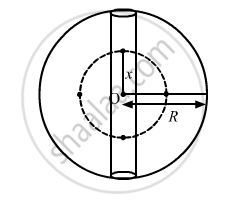
\[\text { Mass of the imaginary sphere }, M' = \left( \frac{4}{3} \right)\pi x^3 \rho . . . (ii)\]
\[\text { From (i) and (ii), we have : }\]
\[\frac{M'}{M} = \frac{x^3}{R^3}\]
∴ Gravitational force on the particle of mass m is given by F \[= \frac{GMm}{x^2}\]
\[\Rightarrow F = \frac{GM x^3 m}{R^3 x^2} = \frac{GMm}{R^3}x\]
APPEARS IN
RELATED QUESTIONS
Write the answer of the question with reference to laws of gravitation.
State the universal law of gravitation.
Choose the correct alternative:
Acceleration due to gravity is independent of mass of the earth/mass of the body.
Write the three laws given by Kepler. How did they help Newton to arrive at the inverse square law of gravity?
Can two particles be in equilibrium under the action of their mutual gravitational force? Can three particles be? Can one of the three particles be?
Let V and E be the gravitational potential and gravitational field at a distance r from the centre of a uniform spherical shell. Consider the following two statements :
(A) The plot of V against r is discontinuous.
(B) The plot of E against r is discontinuous.
Which of the following quantities remain constant in a planetary motion (consider elliptical orbits) as seen from the sun?
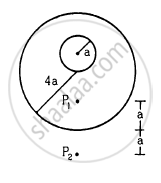
A uniform metal sphere of radius a and mass M is surrounded by a thin uniform spherical shell of equal mass and radius 4a (In the following figure). The centre of the shell falls on the surface of the inner sphere. Find the gravitational field at the points P1 and P2 shown in the figure.
A particle of mass 100 g is kept on the surface of a uniform sphere of mass 10 kg and radius 10 cm. Find the work to be done against the gravitational force between them to take the particle away from the sphere.
The mass of moon is about 0.012 times that of earth and its diameter is about 0.25 times that of earth. The value of G on the moon will be:
A ball is thrown vertically upwards. It goes to a height 20 m and then returns to the ground. Taking acceleration due to gravity g to be 10 ms-2 , find :
the total time of journey of the ball .
How will the force of gravitation between two objects change if the distance between them is:
Almost zero
What does a force do in the following case?
You pull the skin of your arm
What does a force do in the following case?
You twist a piece of rubber.
For the weight of body of mass 5 kg to be zero on equator of the earth, angular velocity of the earth must be (The radius of earth = 6400 km, acceleration due to gravity = 10 m/s2).
If the law of gravitation, instead of being inverse-square law, becomes an inverse-cube law- ______.
- planets will not have elliptic orbits.
- circular orbits of planets is not possible.
- projectile motion of a stone thrown by hand on the surface of the earth will be approximately parabolic.
- there will be no gravitational force inside a spherical shell of uniform density.
The gravitational force between a hollow spherical shell (of radius R and uniform density) and a point mass is F. Show the nature of F vs r graph where r is the distance of the point from the centre of the hollow spherical shell of uniform density.
Write the answer of the question with reference to laws of gravitation.
Write the value of the universal gravitational constant.
Newton's universal law of gravitation applies to ______.
If three equal masses m are placed at the three vertices of an equilateral triangle of side 1/m then what force acts on a particle of mass 2m placed at the centroid?
