Advertisements
Advertisements
Question
The gravitational force between a hollow spherical shell (of radius R and uniform density) and a point mass is F. Show the nature of F vs r graph where r is the distance of the point from the centre of the hollow spherical shell of uniform density.
Advertisements
Solution
Let us consider the diagram of a spherical shell having uniform density (ρ).

Mass of the shell = (Density) × (Volume)
`M = (ρ) xx 4/3 πR^3`
Therefore, the gravitational force between the hollow shell and point mass is`F = (GMm)/r^2` where M is the mass of the hollow spherical shell and m is the mass of point mass.
Therefore, the mass is distributed on the surface of the sphere only, then F = 0 for 0 < r < R (i.e., force inside the shell is zero)
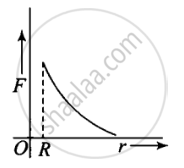
And `F = (GM)/r^2 for `r ≥ R`
The variation of F versus r is shown in the diagram. Force is maximum at the surface of shell and it is zero if r tends to infinity.
APPEARS IN
RELATED QUESTIONS
Two small bodies of masses 10 kg and 20 kg are kept a distance 1.0 m apart and released. Assuming that only mutual gravitational forces are acting, find the speeds of the particles when the separation decreases to 0.5 m.
A semicircular wire has a length L and mass M. A particle of mass m is placed at the centre of the circle. Find the gravitational attraction on the particle due to the wire.
A tunnel is dug along a diameter of the earth. Find the force on a particle of mass m placed in the tunnel at a distance x from the centre.
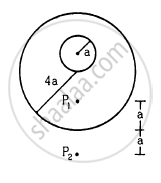
A uniform metal sphere of radius a and mass M is surrounded by a thin uniform spherical shell of equal mass and radius 4a (In the following figure). The centre of the shell falls on the surface of the inner sphere. Find the gravitational field at the points P1 and P2 shown in the figure.
State whether the gravitational force between two masses is attractive or repulsive ?
Define one Newton. How much maximum acceleration can it produce in a mass of 1 kg?
The force of attraction between any two material objects is called __________.
Is the law of gravitation applicable in case of the sun and the moon?
A ball is thrown up with a speed of 4.9 ms-1.
Calculate the time it takes to reach this height.
Where will you weigh more: at the centre of the earth or at the surface of the earth?
A force can produce ________, In an object at rest. It can __________ an object and change its __________ of motion.
Why does a ball moving on a table top eventually stops?
Gravity is another kind of ________. It exerts all through the ________. The Sun's gravity keeps the ___________ in their orbits. Gravity can only be felt with very large ________.
The distance-time values for an object moving along straight line are given below:
| Time (s) | Distance (m) |
| 0 | 0 |
| 1 | 1 |
| 2 | 8 |
| 3 | 27 |
For the weight of body of mass 5 kg to be zero on equator of the earth, angular velocity of the earth must be (The radius of earth = 6400 km, acceleration due to gravity = 10 m/s2).
As observed from earth, the sun appears to move in an approximate circular orbit. For the motion of another planet like mercury as observed from earth, this would ______.
Newton formulated the Universal Law of Gravitation by combining the ideas of which two scientists with his own Laws of Motion?
