Advertisements
Advertisements
Question
Choose the correct alternative:
Acceleration due to gravity increases/decreases with increasing depth. (assume the earth to be a sphere of uniform density).
Advertisements
Solution
Decreases
Acceleration due to gravity at depth d is given by the relation:
`g_d = (1-d/R_e)g`
It is clear from the given relation that acceleration due to gravity decreases with an increase in depth.
APPEARS IN
RELATED QUESTIONS
Calculate the force of gravitation between the earth and the Sun, given that the mass of the earth = 6 × 1024 kg and of the Sun = 2 × 1030 kg. The average distance between the two is 1.5 × 10¹¹ m.
If you compare the gravitational force on the Earth due to the Sun to that due to the Moon, you would find that the Sun’s pull is greater than the Moon’s pull. (You can check this yourself using the data available in the succeeding exercises). However, the tidal effect of the Moon’s pull is greater than the tidal effect of Sun. Why?
Can we apply Newton’s third law to the gravitational force ? Explain your answer.
Inside a uniform spherical shell
(a) the gravitational potential is zero
(b) the gravitational field is zero
(c) the gravitational potential is same everywhere
(d) the gravitational field is same everywhere
Four particles of equal masses M move along a circle of radius R under the action of their mutual gravitational attraction. Find the speed of each particle.
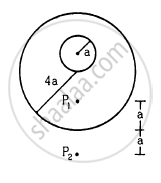
A uniform metal sphere of radius a and mass M is surrounded by a thin uniform spherical shell of equal mass and radius 4a (In the following figure). The centre of the shell falls on the surface of the inner sphere. Find the gravitational field at the points P1 and P2 shown in the figure.
Multiple Choice Question. Select the correct option.
The mass of earth is 6 × 1024 kg and radius of earth is 6.4 × 10⁶ m. The magnitude of force between the mass of 1 kg and the earth is:
Define one Newton. How much maximum acceleration can it produce in a mass of 1 kg?
A ball is thrown up with a speed of 4.9 ms-1.
Calculate the maximum height it would gain before it begins to fall.
What does a force do in the following case?
You pull the skin of your arm
What does a force do in the following case?
You catch a kicked ball.
Name and state the action and reaction in the following case:
Hammering a nail.
Two equal and opposite forces acting at the same point on a stationary body. Will the body move? Give reason to explain your answer.
What is the difference between gravity and gravitation?
What do you mean by a gravitational constant?
Solve the following problem.
Find the gravitational force between the Sun and the Earth.
Given Mass of the Sun = 1.99 × 1030 kg
Mass of the Earth = 5.98 × 1024 kg
The average distance between the Earth and the Sun = 1.5 × 10¹¹ m.
The ______ force is much weaker than other forces in nature.
The gravitational force between a hollow spherical shell (of radius R and uniform density) and a point mass is F. Show the nature of F vs r graph where r is the distance of the point from the centre of the hollow spherical shell of uniform density.
Ocean tides on Earth are mainly caused by ______.
Who measured the value of the Universal Gravitational Constant G using the Cavendish balance?
