Advertisements
Advertisements
Question
Observe the figure and answer the questions:

- State Newton's universal law of gravitation.
- If the distance between the two bodies is tripled, how will the gravitational force between them change?
- What will happen to gravitational force, if mass of one of the object is doubled?
Advertisements
Solution
- According to Newton’s universal law of gravitation theory, every object in the universe attracts every other object with a definite force. This force is directly proportional to the product of the masses of the two objects and is inversely proportional to the square of the distance between them. The above figure shows two objects with masses m1 and m2 kept at a distance d from each other. Mathematically, the gravitational force of attraction between these two bodies can be written as
`Fα (m_1m_2)/d^2 or F= G (m_1m_2)/d^2`
Here, G is the constant of proportionality and is called the universal gravitational constant. - If the distance between the two bodies is tripled, the gravitational force between them would decrease by a factor of 9 (since force is inversely proportional to the square of the distance). This is because according to the law of gravitation, F ∝ `1/d^2`, so if d becomes 3d, then
`F = G(m_1m_2)/(3d^2) = G(m_1m_2)/(9d^2)` - If the mass of one of the objects is doubled, the gravitational force between them will also double. This is because the force is directly proportional to the masses of the objects. So, F ∝ m1 or F ∝ m2, which means if m1 becomes 2m1,
`F = G(2m_1m_2)/(d^2) = 2G(m_1m_2)/(d^2)`
APPEARS IN
RELATED QUESTIONS
Write the formula to find the magnitude of the gravitational force between the earth and an object on the surface of the earth.
How does the force of gravitation between two objects change when the distance between them is reduced to half?
If the moon attracts the earth, why does the earth not move towards the moon?
Answer the following:
You can shield a charge from electrical forces by putting it inside a hollow conductor. Can you shield a body from the gravitational influence of nearby matter by putting it inside a hollow sphere or by some other means?
Choose the correct answer from among the given ones:
For the problem 8.10, the direction of the gravitational intensity at an arbitrary point P is indicated by the arrow (i) d, (ii) e, (iii) f, (iv) g.
State the universal law of gravitation. Name the scientist who gave this law.
Suppose the gravitational potential due to a small system is k/r2 at a distance r from it. What will be the gravitational field? Can you think of any such system? What happens if there were negative masses?
Four particles of equal masses M move along a circle of radius R under the action of their mutual gravitational attraction. Find the speed of each particle.
Two small bodies of masses 10 kg and 20 kg are kept a distance 1.0 m apart and released. Assuming that only mutual gravitational forces are acting, find the speeds of the particles when the separation decreases to 0.5 m.
A uniform metal sphere of radius a and mass M is surrounded by a thin uniform spherical shell of equal mass and radius 4a (In the following figure). The centre of the shell falls on the surface of the inner sphere. Find the gravitational field at the points P1 and P2 shown in the figure.
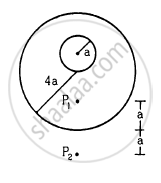
A particle of mass 100 g is kept on the surface of a uniform sphere of mass 10 kg and radius 10 cm. Find the work to be done against the gravitational force between them to take the particle away from the sphere.
The gravitational field in a region is given by \[E = \left( 2 \overrightarrow{i} + 3 \overrightarrow{j} \right) N {kg}^{- 1}\] . Show that no work is done by the gravitational field when a particle is moved on the line 3y + 2x = 5.
[Hint : If a line y = mx + c makes angle θ with the X-axis, m = tan θ.]
Distinguish between gravity and gravitation
The force of attraction between any two material objects is called __________.
Gravity is another kind of ________. It exerts all through the ________. The Sun's gravity keeps the ___________ in their orbits. Gravity can only be felt with very large ________.
Is there a gravitational attraction between you and the book? Explain.
The gravitational force between a hollow spherical shell (of radius R and uniform density) and a point mass is F. Show the nature of F vs r graph where r is the distance of the point from the centre of the hollow spherical shell of uniform density.
Shown are several curves (Figure). Explain with reason, which ones amongst them can be possible trajectories traced by a projectile (neglect air friction).
Complete the chart below.
| F(N) | M1(kg) | M2(kg) | D(m) |
| (a) | 50 | 84 | 02 |
| 16 × 109 | 1.63 × 10²² | (b) | 34 |
Ocean tides on Earth are mainly caused by ______.
