Advertisements
Advertisements
Question
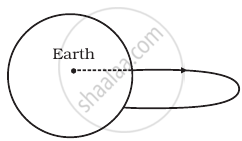
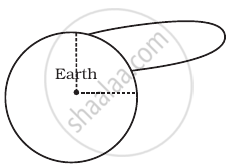
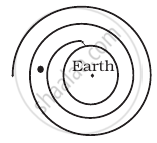
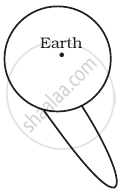
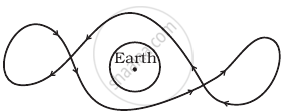
Shown are several curves (Figure). Explain with reason, which ones amongst them can be possible trajectories traced by a projectile (neglect air friction).
Options
Advertisements
Solution
Explanation:
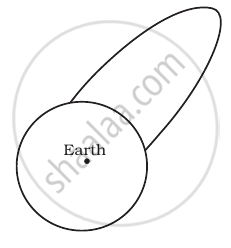
Here, the trajectory of path which is followed by the projectile under the gravitational force of earth will be a conic section or parabolic or elliptical or focus must be with centre. So, accordingly, only is required which shows centre of earth as focus of trajectory.
APPEARS IN
RELATED QUESTIONS
Write the formula to find the magnitude of the gravitational force between the earth and an object on the surface of the earth.
What happens to the force between two objects, if the mass of one object is doubled?
What happens to the force between two objects, if the masses of both objects are doubled?
Choose the correct alternative:
Acceleration due to gravity increases/decreases with increasing depth. (assume the earth to be a sphere of uniform density).
Choose the correct answer from among the given ones:
For the problem 8.10, the direction of the gravitational intensity at an arbitrary point P is indicated by the arrow (i) d, (ii) e, (iii) f, (iv) g.
A rocket is fired from the earth towards the sun. At what distance from the earth’s centre is the gravitational force on the rocket zero? Mass of the sun = 2 ×1030 kg, mass of the earth = 6 × 1024 kg. Neglect the effect of other planets etc. (orbital radius = 1.5 × 10¹¹ m).
How will you ‘weigh the sun’, that is estimate its mass? The mean orbital radius of the earth around the sun is 1.5 × 10⁸ km.
A person sitting in a chair in a satellite feels weightless because
Three uniform spheres each having a mass M and radius a are kept in such a way that each touches the other two. Find the magnitude of the gravitational force on any of the spheres due to the other two.
Four particles of equal masses M move along a circle of radius R under the action of their mutual gravitational attraction. Find the speed of each particle.
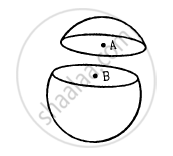
A thin spherical shell having uniform density is cut in two parts by a plane and kept separated as shown in the following figure. The point A is the centre of the plane section of the first part and B is the centre of the plane section of the second part. Show that the gravitational field at A due to the first part is equal in magnitude to the gravitational field at B due to the second part.
Who stated the law of gravitation?
Why does a ball moving on a table top eventually stops?
State the law of gravitation. Why is it called universal?
What is the difference between gravity and gravitation?
Does the force of the earth's gravitation affect the motion of the moon? Explain your answer with reasons.
What do you mean by a gravitational constant?
Give scientific reasons for the following:
Newton's gravitational law is the universal law of gravitation.
If three equal masses m are placed at the three vertices of an equilateral triangle of side 1/m then what force acts on a particle of mass 2m placed at the centroid?
