Advertisements
Advertisements
Question
Answer the following question.
State Newton’s law of gravitation and express it in vector form.
Advertisements
Solution
- Statement:
Every particle of matter attracts every other particle of matter with a force that is directly proportional to the product of their masses and inversely proportional to the square of the distance between them. - In vector form, it can be expressed as,
`vec"F"_21 = "G" ("m"_1"m"_2)/"r"^2(- hat"r"_21)`
where, `hat"r"_21` is the unit vector from m1 to m2. The force `vec"F"_21` is directed from m2 to m1.
APPEARS IN
RELATED QUESTIONS
How does the force of gravitation between two objects change when the distance between them is reduced to half?
What is the magnitude of the gravitational force between the earth and a 1 kg object on its surface? (Mass of the earth is 6 × 1024 kg and radius of the earth is 6.4 × 10⁶ m).
What happens to the force between two objects, if the distance between the objects is doubled and tripled?
Choose the correct answer from among the given ones:
For the problem 8.10, the direction of the gravitational intensity at an arbitrary point P is indicated by the arrow (i) d, (ii) e, (iii) f, (iv) g.
State the universal law of gravitation. Name the scientist who gave this law.
State and explain Kepler's laws of planetary motion. Draw diagrams to illustrate these laws.
Which of the following quantities remain constant in a planetary motion (consider elliptical orbits) as seen from the sun?
Three uniform spheres each having a mass M and radius a are kept in such a way that each touches the other two. Find the magnitude of the gravitational force on any of the spheres due to the other two.
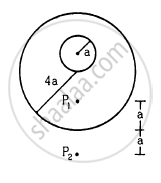
A uniform metal sphere of radius a and mass M is surrounded by a thin uniform spherical shell of equal mass and radius 4a (In the following figure). The centre of the shell falls on the surface of the inner sphere. Find the gravitational field at the points P1 and P2 shown in the figure.
Write an expression for the gravitational force of attraction between two bodies of masses m1 and m2 separated by a distance r.
Multiple Choice Question. Select the correct option.
The mass of earth is 6 × 1024 kg and radius of earth is 6.4 × 10⁶ m. The magnitude of force between the mass of 1 kg and the earth is:
All objects in the universe attract each other along the line joining their________.
Where will you weigh more: at the centre of the earth or at the surface of the earth?
What does a force do in the following case?
You pull the skin of your arm
Is there a gravitational attraction between you and the book? Explain.
An apple falls towards the earth due to its gravitational force. The apple also attracts the earth with the same force. Why do we not see the earth rising towards the apple? Explain.
Give the applications of universal law gravitation.
The force of gravitation between two bodies of mass 1 kg each separated by a distance of 1 m in vacuum is ____________.
As observed from earth, the sun appears to move in an approximate circular orbit. For the motion of another planet like mercury as observed from earth, this would ______.
Particles of masses 2M, m and M are respectively at points A, B and C with AB = ½ (BC). m is much-much smaller than M and at time t = 0, they are all at rest (Figure). At subsequent times before any collision takes place ______.

If the law of gravitation, instead of being inverse-square law, becomes an inverse-cube law- ______.
- planets will not have elliptic orbits.
- circular orbits of planets is not possible.
- projectile motion of a stone thrown by hand on the surface of the earth will be approximately parabolic.
- there will be no gravitational force inside a spherical shell of uniform density.
We can shield a charge from electric fields by putting it inside a hollow conductor. Can we shield a body from the gravitational influence of nearby matter by putting it inside a hollow sphere or by some other means?
The gravitational force between a hollow spherical shell (of radius R and uniform density) and a point mass is F. Show the nature of F vs r graph where r is the distance of the point from the centre of the hollow spherical shell of uniform density.
Give scientific reasons for the following:
Newton's gravitational law is the universal law of gravitation.
A hollow spherical shell of uniform density exerts what gravitational force on a point mass placed inside it?
The gravitational force between two objects acts in which direction?
