Advertisements
Advertisements
Question
A ball is thrown up with a speed of 4.9 ms-1.
Prove that the time of ascent is equal to the time of descent.
Advertisements
Solution
For highest point initial velocity is zero
Acceleration due to gravity is = 9.8 ms-2.
Final velocity at ground is v
V2 - 0 = 2 X9.8 X 1.125
V = 4.9 ms-1.
Time taken to reach ground from highest point
V = u + at
4.9 = 0 + 9.8 t
T = 4.9/9.8 = 0.5 sec.
So time of ascent is equal to time descent.
APPEARS IN
RELATED QUESTIONS
Can we apply Newton’s third law to the gravitational force ? Explain your answer.
Write the three laws given by Kepler. How did they help Newton to arrive at the inverse square law of gravity?
A tunnel is dug along a diameter of the earth. Find the force on a particle of mass m placed in the tunnel at a distance x from the centre.
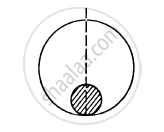
A solid sphere of mass m and radius r is placed inside a hollow thin spherical shell of mass M and radius R as shown in the following figure . A particle of mass m' is placed on the line joining the two centres at a distance x from the point of contact of the sphere and the shell. Find the magnitude of the resultant gravitational force on this particle due to the sphere and the shell if (a) r < x < 2r, (b) 2r < x < 2R and (c) x > 2R.
Multiple Choice Question. Select the correct option.
The mass of earth is 6 × 1024 kg and radius of earth is 6.4 × 10⁶ m. The magnitude of force between the mass of 1 kg and the earth is:
Who stated the law of gravitation?
How will the force of gravitation between two objects change if the distance between them is:
Doubled
The ______ force is much weaker than other forces in nature.
Three uniform spheres, each having mass m and radius r, are kept in such a way that each touches the other two. The magnitude of the gravitational force on any sphere due to the other two is
If the mass of one object is doubled and distance remains the same, the gravitational force will ______.
