Advertisements
Advertisements
प्रश्न
A ball is thrown up with a speed of 4.9 ms-1.
Prove that the time of ascent is equal to the time of descent.
Advertisements
उत्तर
For highest point initial velocity is zero
Acceleration due to gravity is = 9.8 ms-2.
Final velocity at ground is v
V2 - 0 = 2 X9.8 X 1.125
V = 4.9 ms-1.
Time taken to reach ground from highest point
V = u + at
4.9 = 0 + 9.8 t
T = 4.9/9.8 = 0.5 sec.
So time of ascent is equal to time descent.
APPEARS IN
संबंधित प्रश्न
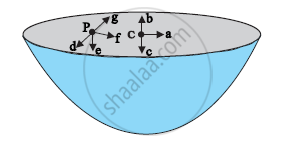
The gravitational intensity at the centre of a hemispherical shell of uniform mass density has the direction indicated by the arrow (see Fig 8.12) (i) a, (ii) b, (iii) c, (iv) 0.
A rocket is fired from the earth towards the sun. At what distance from the earth’s centre is the gravitational force on the rocket zero? Mass of the sun = 2 ×1030 kg, mass of the earth = 6 × 1024 kg. Neglect the effect of other planets etc. (orbital radius = 1.5 × 10¹¹ m).
Which of the following quantities remain constant in a planetary motion (consider elliptical orbits) as seen from the sun?
Four particles of equal masses M move along a circle of radius R under the action of their mutual gravitational attraction. Find the speed of each particle.
Explain the following:
People often shake the branches of a tree for getting down its fruits.
The force of attraction between any two material objects is called __________.
What is meant by the equation :
`g= Gxxm/r^2`
where the symbols have their usual meanings.
What does a force do in the following case?
You pull the skin of your arm
The distance-time values for an object moving along straight line are given below:
| Time (s) | Distance (m) |
| 0 | 0 |
| 1 | 1 |
| 2 | 8 |
| 3 | 27 |
Complete the chart below.
| F(N) | M1(kg) | M2(kg) | D(m) |
| (a) | 50 | 84 | 02 |
| 16 × 109 | 1.63 × 10²² | (b) | 34 |
