Advertisements
Chapters
2: Motion in One Dimension
▶ 3: Laws of Motion
4: Fluids
5: Heat
6: Light
7: Sound
8: Electricity and Magnetism
![Frank solutions for Physics [English] Class 9 ICSE chapter 3 - Laws of Motion - Shaalaa.com](/images/physics-english-class-9-icse_6:1a0f7706074c4feda1fb5ca0ff12ac66.jpg "Frank solutions for Physics [English] Class 9 ICSE chapter 3 - Laws of Motion")
Advertisements
Solutions for Chapter 3: Laws of Motion
Below listed, you can find solutions for Chapter 3 of CISCE Frank for Physics [English] Class 9 ICSE.
Frank solutions for Physics [English] Class 9 ICSE 3 Laws of Motion Exercise 1 [Pages 113 - 114]
What do you mean by inertia of motion?
Give one example each of inertia of rest and inertia of motion.
The greater is the __________ the greater is the inertia of an object.
Name the different kinds of inertia an object can possess. Give an example of each.
Define one Newton. How much maximum acceleration can it produce in a mass of 1 kg?
The acceleration produced by a force in an object is directly proportional to the applied _________ And inversely proportional to the _________ Of the object.
What is the SI unit of force?
Name the physical quantity associated with N kg-1.
The CGS unit of force is dyne:
∴1 N = __________ dyne
When a sports car and a loaded van are travelling at a speed of 50 km/h, which vehicle requires more force to stop?
What is the acceleration produced by a force of 12 N exerted on an object of mass 4 kg?
What is the ratio of SI to CGs units of force?
Write the SI unit of momentum.
Define momentum of a body.
Name the physical quantity associated with the motion of a body.
Which has more momentum: a fast pitched soft ball or a soft pitched soft ball?
What is the ratio of SI units to CGS units of momentum?
What will be the momentum of a body at rest?
State Newton's third law of motion.
What do you mean by action?
Do action and reaction act on the same body?
ame the law of motion which gives the definition of force.
Is force a scalar or a vector quantity?
If a number of forces act on a stationary body at the same point, then what do you conclude from it?
Why do passengers tend to fall sideways when the bus takes a sharp turn?
Why are passengers thrown in the forward direction when a running bus stops suddenly?
Why do passengers tend to fall backward when it starts suddenly?
Can internal forces change the velocity of a body?
Why do the dust particles come out of a hanging carpet when it is beaten with a stick?
Why is a tree shaken to get its fruit down?
Which would require a greater force: accelerating a 10 g mass at 5 ms-2, or accelerating a 20 g mass of 2 ms-2?
The velocity-time graph of a coin moving on a table is shown in the below figure. If the mass of the coin is 20 g, then how much force does the table exert on the coin to bring it to rest?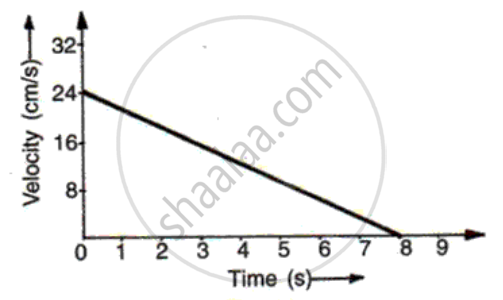
An object undergoes an acceleration of 8 ms-2 starting from rest. Find the distance travelled in 5 seconds.
A truck rolls down a hill with constant acceleration after starting from rest. It travels a distance of 100 m in 10 s. find its acceleration. Find the force acting on it, if its mass is 5 metric tons. (tonne)
Name the physical entity used for quantifying the motion of a body.
Why do you feel a backward jerk on your shoulder when you fire a gun?
How does a person move forward during swimming?
Name the principle involved in the working of a jet engine.
Is the statement correct?
A rocket can propel itself in vacuum.
Since action and reaction forces are always equal in magnitude and opposite in direction, how can anything be ever accelerated?
Frank solutions for Physics [English] Class 9 ICSE 3 Laws of Motion Exercise 2 [Pages 125 - 126]
Who stated the law of gravitation?
Write the answer of the question with reference to laws of gravitation.
State the universal law of gravitation.
Distinguish between gravity and gravitation
Define acceleration due to gravity.
Write the relation between g and G
Define the constant of gravitation.
What are the SI units of constant of gravitation?
How will the force of gravitation between two objects change if the distance between them is:
Halved
How will the force of gravitation between two objects change if the distance between them is:
Doubled
How will the force of gravitation between two objects change if the distance between them is:
Made four times
How will the force of gravitation between two objects change if the distance between them is:
Infinite
How will the force of gravitation between two objects change if the distance between them is:
Almost zero
All objects in the universe attract each other along the line joining their________.
The force of attraction between any two material objects is called __________.
The gravitational force of the earth is called earth's __________.
he gravity is a particular case of _________.
The value of G is extremely____________.
Small
large
large
Is the law of gravitation applicable in case of the sun and the moon?
Given:
Mass of the earth = 6X1024kg.
Radius of the earth = 6.4 X 10⁶ m
G = 6.7 x 10¹¹Nm2kg-2
Using this data, calculate the force of gravity due to the earth acting on a 100 kg person stannding on the ground.
Why do objects fall towards the earth?
Why don't you feel the force of attraction between your friend sitting close to you and yourself?
A ball is thrown up with a speed of 4.9 ms-1.
Calculate the maximum height it would gain before it begins to fall.
A ball is thrown up with a speed of 4.9 ms-1.
Calculate the time it takes to reach this height.
A ball is thrown up with a speed of 4.9 ms-1.
Prove that the time of ascent is equal to the time of descent.
What is the relation between 'g' and 'G'?
What is the value of g at the surface of the earth?
When some rock is brought to the earth from the surface of the moon, Will its mass and weight change?
Where will you weigh more: at the centre of the earth or at the surface of the earth?
Name an instrument used to measure the mass of a body.
Name the instrument by which the weight of a body can be measured.
Where do you weigh more: at the poles or at equator?
How are kgwt and N related to each other?
Where will you weigh more: at the moon's surface or at the earth's surface?
Does the force of gravitation between two objects depend on the medium between them?
What will happen to the gravitational force of attraction between two objects if the mass of each is doubled and the distance between them is also doubled?
In vacuum, all freely falling objects have the same force. Is it true?
What is meant by the equation :
`g= Gxxm/r^2`
where the symbols have their usual meanings.
State whether the below statement is True or False.
Neglecting air resistance, a body falling freely near the earth's surface has a constant acceleration.
On top of the Mount Everest
On top of Qutub Minar
At a place on the equator
A camp site in Antarctica
At what height above the earth's surface would the value of acceleration due to gravity be half of what it is on the surface? Take the radius of earth to be R.
Frank solutions for Physics [English] Class 9 ICSE 3 Laws of Motion Exercise 3 [Pages 128 - 131]
What is a force?
Define one newton.
What is the relation between Newton and dyne?
Is force a scalar quantity?
A force can produce ________, In an object at rest. It can __________ an object and change its __________ of motion.
What does a force do in the following case?
You pull the skin of your arm
What does a force do in the following case?
You twist a piece of rubber.
What does a force do in the following case?
You apply brakes to a running car.
What does a force do in the following case?
You catch a kicked ball.
Can every force produced motion in every type of body?
The amount of inertia of a body depends on its _________.
You can change the direction in which an object is moving by___________.
A man riding on a car has ___________ Inertia.
What do you mean by inertia of rest?
Name and state the action and reaction in the following case:
A book lying on a table.
Name and state the action and reaction in the following case:
A person walking on the ground.
Name and state the action and reaction in the following case:
Hammering a nail.
Name and state the action and reaction in the following case:
Firing a bullet from a gun.
Name and state the action and reaction in the following case:
Pushing a wall.
Give two examples of the following:
Inertia of rest
Give two examples of the following:
Inertia of motion
What causes motion in a body?
What do you mean by linear momentum of a body?
Write the SI unit of momentum.
Give qualitative definition of force on the basic of Newton's first law of motion.
State Newton's first law of motion.
Which of the following has the largest inertia?
A car
A truck
A cricket ball
A ball pen
Why is it advantageous to turn before taking a long jump?
Why does a ball moving on a table top eventually stops?
Name the physical quantity which equals the rate of change of linear momentum.
State Newton's second law of motion. Is Newton's first law of motion contained in Newton's second law of motion?
Define one newton. What is the ratio of SI to CGS units of force?
Prove that 1 N = 105 dyne. Is 1 N same as 1 kgms-2?
Two equal and opposite forces acting at the same point on a stationary body. Will the body move? Give reason to explain your answer.
Two equal and opposite forces act on a moving body. How is its motion affected?
State Newton's third law of motion. Explain, the motion of a rocket with the help of Newton's third law of motion.
A boy pushes a wall with a force of 30 N towards east. What force is exerted by the wall on the boy?
Name the scientist who first stated the law of inertia.
State the law of gravitation. Why is it called universal?
What is the difference between gravity and gravitation?
Where will a person weigh more: at Simla or at Delhi?
Name the instrument used to measure the weight of a body.
Gravity is another kind of ________. It exerts all through the ________. The Sun's gravity keeps the ___________ in their orbits. Gravity can only be felt with very large ________.
Explain why:
Objects fall to the earth.
Explain why:
The atmosphere does not escape.
Explain why:
A moon rocket needs to reach a certain velocity.
Explain the difference between g and G.
What do you understand by the free fall?
Is there a gravitational attraction between you and the book? Explain.
Does the force of the earth's gravitation affect the motion of the moon? Explain your answer with reasons.
Differentiate between gravitational mass and inertial mass.
State Newton's law of gravitation. What is the difference between:
Gravity and gravitation
State Newton's law of gravitation. What is the difference between:
g and G?
An apple falls towards the earth due to its gravitational force. The apple also attracts the earth with the same force. Why do we not see the earth rising towards the apple? Explain.
Show that gravity decreases at higher altitudes.
In the below figure, a block of weight 20 N is hanging from a rigid support by a string. Find:
The force exerted by block on the string.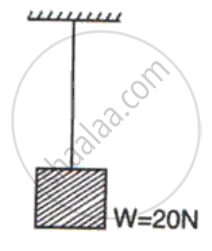
In the below figure, a block of weight 20 N is hanging from a rigid support by a string. Find:
The force exerted by string on the block.
A force of 4 N gives a mass m1 an acceleration of 8 ms-2 and a mass m2 an acceleration of 20 ms-2. What would be the acceleration if the same force acts on both the masses tied together?
The speed-time graph of a body having a mass of 100 g moving along a straight line path is shown here. Find the force acting on the body.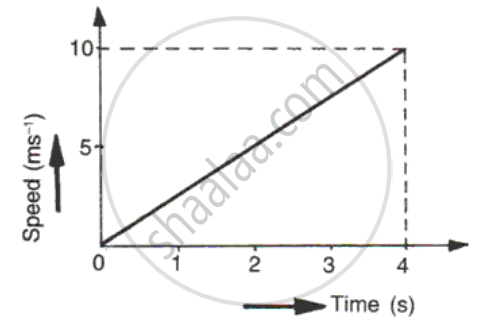
A force of 0.9 N acting on a body increases its velocity from 5 ms-1 to 8 ms-1 in 2 s. Calculate the mass of the body.
The distance-time values for an object moving along straight line are given below:
| Time (s) | Distance (m) |
| 0 | 0 |
| 1 | 1 |
| 2 | 8 |
| 3 | 27 |
What do you mean by an impulsive force?
For how long should a force of 100 N act on a body of mass 20 kg so that it acquires a velocity of 100 ms-1?
Write the SI unit of retardation.
What is the relationship between force and acceleration?
State Newton's second law of motion.
A body of mass 400 g is resting on a frictionless table. Find the acceleration of the body when acted upon by a force of 0.02 N.
What do you mean by linear momentum of a body? A force causes an acceleration of 10 ms-2 in a body of mass 1 kg. What acceleration will be caused by the same force in a body of mass 4 kg?
Two bodies P and Q, of same masses m and 2m are moving with velocities 2 v and v respectively. Compare their
(i) Inertia, (ii) Momentum, and (iii) The force required to stop them in the same time.
Show that the rate of change of momentum = mass × acceleration. Under what condition does this relation hold?
What do you mean by the conservation of momentum? Briefly, explain the collision between two bodies and the conservation of momentum.
State Newton's third law of motion. Give an experimental demonstration of Newton's third law.
A force acts for 0.1 s on a body of mass 2.0 kg initially at rest. The force is then withdrawn and the body moves with a velocity of 2 ms-1. Find the average force applied by the player
A cricket ball of mass 500 g moving at a speed of 30 ms 1 is brought to rest by a player in 0.03 s. Find the average force applied by the player.
A force acts for 0.1 s on a body of mass 3.2 kg initially at rest. The force then ceases to act and the body moves through 3 m in the next one second. Calculate the magnitude of force.
Below Figure shows the velocity-time graph of a particle of mass 200 g moving in a stra ight line. Calculate the force acting on the particle.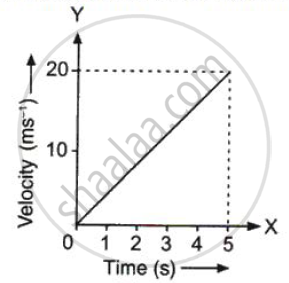
A force of 10 N acts on a body of mass 2 kg for 3 s, initially at rest. Calculate:
The velocity acquired by the body.
A force of 10 N acts on a body of mass 2 kg for 3 s, initially at rest. Calculate:
Change in momentum of the body.
Use Newton's second law to explain the following:
We always prefer to land on sand instead of hard floor while taking a high jump.
Use Newton's second law to explain the following:
While catching a fast moving ball, we always pull our hands backwards.
A stone is dropped from a cliff 98 m high.
How long will it take to fall to the foot of the cliff?
A stone is dropped from a cliff 98 m high.
What will be its speed when it strikes the ground?
A stone is thrown vertically upward with a velocity of 9.8 m/s. When will it reach the ground?
A ball is thrown vertically downward with an initial velocity of 10 m/s. What is its speed 1 s later and 2 s later?
A ball is thrown upward and reaches a maximum height of 19.6 m. Find its initial speed?
A stone is dropped from a tower 98 m high. With what speed should a second stone be thrown 1 s later so that both hit the ground at the same time?
Solutions for 3: Laws of Motion
Frank solutions for Physics [English] Class 9 ICSE chapter 3 - Laws of Motion
Shaalaa.com has the CISCE Mathematics Physics [English] Class 9 ICSE CISCE solutions in a manner that help students grasp basic concepts better and faster. The detailed, step-by-step solutions will help you understand the concepts better and clarify any confusion. Frank solutions for Mathematics Physics [English] Class 9 ICSE CISCE 3 (Laws of Motion) include all questions with answers and detailed explanations. This will clear students' doubts about questions and improve their application skills while preparing for board exams.
Further, we at Shaalaa.com provide such solutions so students can prepare for written exams. Frank textbook solutions can be a core help for self-study and provide excellent self-help guidance for students.
Concepts covered in Physics [English] Class 9 ICSE chapter 3 Laws of Motion are Newton's First Law of Motion, Free Fall, Gravitational Units of Force, Newton's Universal Law of Gravitation, Newton's Third Law of Motion, Force Due to Gravity, Acceleration Due to Gravity (Earth’s Gravitational Acceleration), Newton’s Second Law of Motion, Mass and Weight, Effect of Force, Inertia and Mass, Types of Inertia, Linear Momentum, Change in Momentum, Rate of Change of Momentum, Types of Forces>Contact and Non-Contact Forces.
Using Frank Physics [English] Class 9 ICSE solutions Laws of Motion exercise by students is an easy way to prepare for the exams, as they involve solutions arranged chapter-wise and also page-wise. The questions involved in Frank Solutions are essential questions that can be asked in the final exam. Maximum CISCE Physics [English] Class 9 ICSE students prefer Frank Textbook Solutions to score more in exams.
Get the free view of Chapter 3, Laws of Motion Physics [English] Class 9 ICSE additional questions for Mathematics Physics [English] Class 9 ICSE CISCE, and you can use Shaalaa.com to keep it handy for your exam preparation.
