Advertisements
Advertisements
प्रश्न
Give two examples of the following:
Inertia of motion
Advertisements
उत्तर
A ball rolling on the ground will continue to roll unless the external force , the force of friction between the ball and the ground stops it.This is an example of inertia of motion.
APPEARS IN
संबंधित प्रश्न
When a carpet is beaten with a stick, dust comes out of it. Explain.
Fill in the following blank with suitable word :
Newton’s first law of motion is also called Galileo’s law of ………………………
A moving bicycle comes to rest after sometime if we stop pedalling it. But Newton’s first law of motion says that a moving body should continue to move for ever, unless some external force acts on it. How do you explain the bicycle case ?
Consider a book lying on a table. The weight of the book and the normal force by the table in the book are equal in magnitude and opposite in direction. Is this an example of Newton's third law?
A particle is found to be at rest when seen from a frame S1 and moving with constant velocity when seen from another frame S2. Mark out the possible options.
(a) Both the frames are inertial.
(b) Both the frames are non-inertial.
(c) S1 is inertial and S2 is non-inertial.
(d) S1 is non-inertial and S2 is inertial
If a 5 N and a 15 N forces are acting opposite to one another. Find the resultant force and the direction of action of the resultant force.
When a bus suddenly takes a tum, the passengers are thrown outwards because of
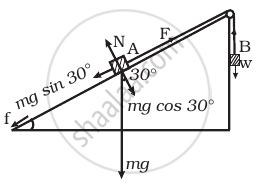
Block A of weight 100 N rests on a frictionless inclined plane of slope angle 30° (figure). A flexible cord attached to A passes over a frictonless pulley and is connected to block B of weight W. Find the weight W for which the system is in equilibrium.
What is the significance of Newton’s first law?
An insect is at the bottom of a hemispherical ditch of radius 1 m. It crawls up the ditch but starts slipping after it is at height h from the bottom. If the coefficient of friction between the ground and the insect is 0.75, then h is ______. (g = 10 ms−2)
