Advertisements
Advertisements
प्रश्न
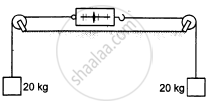
The figure shows a light spring balance connected to two blocks of mass 20 kg each. The graduations in the balance measure the tension in the spring. (a) What is the reading of the balance? (b) Will the reading change if the balance is heavy, say 2.0 kg? (c) What will happen if the spring is light but the blocks have unequal masses?
Advertisements
उत्तर
(a)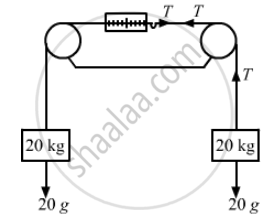
The reading of the balance = Tension in the string
And tension in the string = 20g
So, the reading of the balance = 20g = 200 N
(b) If the balance is heavy, the reading will not change because the weight of spring balance does not affect the tension in the string.
(c) If the blocks have unequal masses, the spring balance will accelerate towards the heavy block with an acceleration a. Then the reading will be equal to the tension in the string.
Suppose m1 > m2.
Then tension in the string,
\[T = \frac{2 m_1 m_2 g}{m_1 + m_2}\].
APPEARS IN
संबंधित प्रश्न
When a carpet is beaten with a stick, dust comes out of it. Explain.
A batsman hits a cricket ball which then rolls on a level ground. After covering a short distance, the ball comes to rest. The ball slows to a stop because ______.
What is the other name of Newton’s first law of motion ?
Name the physical quantity whose unit is ‘newton’.
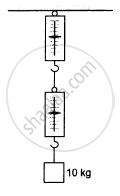
A block of mass 10 kg is suspended from two light spring balances, as shown in the following figure.
A force F1 acts on a particle accelerating it from rest to a velocity v. Force F1 is then replaced by F2 which decelerates the particle to rest.
A particle is found to be at rest when seen from a frame S1 and moving with constant velocity when seen from another frame S2. Mark out the possible options.
(a) Both the frames are inertial.
(b) Both the frames are non-inertial.
(c) S1 is inertial and S2 is non-inertial.
(d) S1 is non-inertial and S2 is inertial
The force exerted by the floor of an elevator on the foot of a person is more than the weight of the person if the elevator is
(a) going up and slowing down
(b) going up and speeding up
(c) going down and slowing down
(d) going down and speeding up
State Newton's first law of motion.
State and explain the law of inertia (or Newton's first law of motion).
Give qualitative definition of force on the basic of Newton's first law of motion.
A force of 600 dynes acts on a glass ball of mass 200 g for 12 s. If initially, the ball is at rest, find
- Final velocity
- Distance covered.
What do you mean by inertia of motion?
Give one example each of inertia of rest and inertia of motion.
The amount of inertia of a body depends on its _________.
Name the scientist who first stated the law of inertia.
Match the following
| Column I | Column II |
| Newton’s I law | propulsion of a rocket |
| Newton’s II law | Stable equilibrium of a body |
| Newton’s III law | Law of force |
| Law of conservation of linear momentum | Flying nature of bird |
A smooth sphere of radius R and mass M is placed on the smooth horizontal floor. Another smooth particle of mass m is placed on the sphere and a horizontal force F is applied on the sphere as shown. If the particle does not slip on the sphere then the value of force F is ______.

What does inertia measure in an object?
When does an object accelerate?
