Advertisements
Advertisements
Question
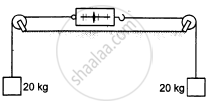
The figure shows a light spring balance connected to two blocks of mass 20 kg each. The graduations in the balance measure the tension in the spring. (a) What is the reading of the balance? (b) Will the reading change if the balance is heavy, say 2.0 kg? (c) What will happen if the spring is light but the blocks have unequal masses?
Advertisements
Solution
(a)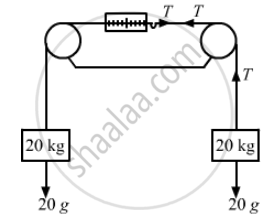
The reading of the balance = Tension in the string
And tension in the string = 20g
So, the reading of the balance = 20g = 200 N
(b) If the balance is heavy, the reading will not change because the weight of spring balance does not affect the tension in the string.
(c) If the blocks have unequal masses, the spring balance will accelerate towards the heavy block with an acceleration a. Then the reading will be equal to the tension in the string.
Suppose m1 > m2.
Then tension in the string,
\[T = \frac{2 m_1 m_2 g}{m_1 + m_2}\].
APPEARS IN
RELATED QUESTIONS
When a carpet is beaten with a stick, dust comes out of it. Explain.
Give the magnitude and direction of the net force acting on a drop of rain falling down with a constant speed.
It is sometimes heard that the inertial frame of reference is only an ideal concept and no such inertial frame actually exists. Comment.
Neglect the effect of rotation of the earth. Suppose the earth suddenly stops attracting objects placed near its surface. A person standing on the surface of the earth will.
Three rigid rods are joined to form an equilateral triangle ABC of side 1 m. Three particles carrying charges 20 μC each are attached to the vertices of the triangle. The whole system is at rest in an inertial frame. The magnitude of the resultant force on the charged particle at A is.
A reference frame attached to the earth
(a) is an inertial frame by definition
(b) cannot be an inertial frame because the earth is revolving around the sun
(c) is an inertial frame because Newton's laws are applicable in this frame
(d) cannot be an inertial frame because the earth is rotating about its axis.
A particle is observed from two frames S1 and S2. Frame S2 moves with respect to S1with an acceleration a. Let F1 and F2 be the pseudo forces on the particle when seen from S1 and S2, respectively. Which of the following is not possible?
Name the scientist who first stated the law of inertia.
Differentiate between gravitational mass and inertial mass.
Match the following
| Column I | Column II |
| Newton’s I law | propulsion of a rocket |
| Newton’s II law | Stable equilibrium of a body |
| Newton’s III law | Law of force |
| Law of conservation of linear momentum | Flying nature of bird |
Classify the types of force based on their application.
When a bus suddenly takes a tum, the passengers are thrown outwards because of
In the above given problem if the lower thread is pulled with a jerk, what happens?
In a legend, the hero-kid kicked a toy pig so that it is projected with a speed greater than that of its cry. If the weight of the toy pig is assumed to be 5 kg and the time of contact 0.01 sec., the force with which the hero-kid kicked him was ______.
(Speed of cry = 330 m/s)
A smooth sphere of radius R and mass M is placed on the smooth horizontal floor. Another smooth particle of mass m is placed on the sphere and a horizontal force F is applied on the sphere as shown. If the particle does not slip on the sphere then the value of force F is ______.

A force F is applied to the initially stationary cart. The variation of force with time is shown in the figure. The speed of the cart at t = 5 sec is ______.

A balloon has mass of 10 g in air. The air escapes from the balloon at a uniform rate with velocity 4.5 cm/s. If the balloon shrinks in 5 s completely. Then, the average force acting on that balloon will be (in dyne).
Match the following.
| Column I | Column II |
| a. Newton’s I law | propulsion of a rocket |
| b. Newton’s II law | Stable equilibrium of the body |
| c. Newton’s III law | Law of force |
| d. Law of conservation of Linear momentum | Flying nature of bird |
An insect is at the bottom of a hemispherical ditch of radius 1 m. It crawls up the ditch but starts slipping after it is at height h from the bottom. If the coefficient of friction between the ground and the insect is 0.75, then h is ______. (g = 10 ms−2)
