Advertisements
Advertisements
Question
It is sometimes heard that the inertial frame of reference is only an ideal concept and no such inertial frame actually exists. Comment.
Advertisements
Solution
We can't find a body whose acceleration is zero with respect to all other bodies in the universe because every body in the universe is moving with respect to other bodies.As we live on earth which itself is accelerates due to its revolution around the sun and spinning about its own axis, so whatever observations and measurements ,we make , are w.r.t to earth which itself is not an inertial frame.Similarly all other planets are also in motion around the sun so ideally no inertial frame is possible.
APPEARS IN
RELATED QUESTIONS
When a carpet is beaten with a stick, dust comes out of it. Explain.
A batsman hits a cricket ball which then rolls on a level ground. After covering a short distance, the ball comes to rest. The ball slows to a stop because ______.
Name the scientist who gave the laws of motion.
The figure shows a light spring balance connected to two blocks of mass 20 kg each. The graduations in the balance measure the tension in the spring. (a) What is the reading of the balance? (b) Will the reading change if the balance is heavy, say 2.0 kg? (c) What will happen if the spring is light but the blocks have unequal masses?

The acceleration of a particle is zero, as measured from an inertial frame of reference. Can we conclude that no force acts on the particle?
A block of mass 10 kg is suspended from two light spring balances, as shown in the following figure.

Three rigid rods are joined to form an equilateral triangle ABC of side 1 m. Three particles carrying charges 20 μC each are attached to the vertices of the triangle. The whole system is at rest in an inertial frame. The magnitude of the resultant force on the charged particle at A is.
The force exerted by the floor of an elevator on the foot of a person is more than the weight of the person if the elevator is
(a) going up and slowing down
(b) going up and speeding up
(c) going down and slowing down
(d) going down and speeding up
If you jump barefoot on a hard surface, your legs are injured. But they are not injured if you jump on a soft surface like sand or pillow. Why?
State and explain the law of inertia (or Newton's first law of motion).
Give qualitative definition of force on the basic of Newton's first law of motion.
A force of 600 dynes acts on a glass ball of mass 200 g for 12 s. If initially, the ball is at rest, find
- Final velocity
- Distance covered.
Give one example each of inertia of rest and inertia of motion.
Differentiate between gravitational mass and inertial mass.
A car of mass m starts from rest and acquires a velocity along east `v = vhati (v > 0)` in two seconds. Assuming the car moves with uniform acceleration, the force exerted on the car is ______.
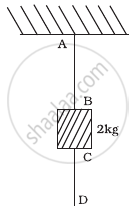
A mass of 2 kg is suspended with thread AB (Figure). Thread CD of the same type is attached to the other end of 2 kg mass. Lower thread is pulled gradually, harder and harder in the downward directon so as to apply force on AB. Which of the threads will break and why?
If the net force on an object is zero, what happens?
An insect is at the bottom of a hemispherical ditch of radius 1 m. It crawls up the ditch but starts slipping after it is at height h from the bottom. If the coefficient of friction between the ground and the insect is 0.75, then h is ______. (g = 10 ms−2)
