Advertisements
Advertisements
Question
A moving bicycle comes to rest after sometime if we stop pedalling it. But Newton’s first law of motion says that a moving body should continue to move for ever, unless some external force acts on it. How do you explain the bicycle case ?
Advertisements
Solution
If we stop pedalling a bicycle, moving at a uniform speed, it does not go on moving forever. It eventually comes to rest after some time. This is because the moving bicycle has been compelled to change its state of uniform motion by the external force of air resistance and friction. If there were no air resistance and no friction to oppose the motion of the bicycle, then, according to the first law of motion, the moving bicycle would go on moving forever on a horizontal road. It cannot stop by itself.
APPEARS IN
RELATED QUESTIONS
Name the scientist who gave the laws of motion.
Define one newton force.
A plumb bob is hung from the ceiling of a train compartment. If the train moves with an acceleration 'a' along a straight horizontal track , the string supporting the bob makes an angle tan−1 (a/g) with the normal to the ceiling. Suppose the train moves on an inclined straight track with uniform velocity. If the angle of incline is tan−1 (a/g), the string again makes the same angle with the normal to the ceiling. Can a person sitting inside the compartment tell by looking at the plumb line whether the train is accelerating on a horizontal straight track or moving on an incline? If yes, how? If not, then suggest a method to do so.
How does Newton's second law of motion differ from the first law of motion?
The amount of inertia of a body depends on its _________.
When a bus suddenly takes a tum, the passengers are thrown outwards because of
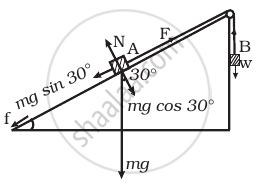
Block A of weight 100 N rests on a frictionless inclined plane of slope angle 30° (figure). A flexible cord attached to A passes over a frictonless pulley and is connected to block B of weight W. Find the weight W for which the system is in equilibrium.
In a legend, the hero-kid kicked a toy pig so that it is projected with a speed greater than that of its cry. If the weight of the toy pig is assumed to be 5 kg and the time of contact 0.01 sec., the force with which the hero-kid kicked him was ______.
(Speed of cry = 330 m/s)
Two blocks A and B of masses m and 2 m, respectively, are held at rest such that the spring is in natural length. Find out the accelerations of both the blocks just after release.

What is the significance of Newton’s first law?
