Advertisements
Advertisements
प्रश्न
A moving bicycle comes to rest after sometime if we stop pedalling it. But Newton’s first law of motion says that a moving body should continue to move for ever, unless some external force acts on it. How do you explain the bicycle case ?
Advertisements
उत्तर
If we stop pedalling a bicycle, moving at a uniform speed, it does not go on moving forever. It eventually comes to rest after some time. This is because the moving bicycle has been compelled to change its state of uniform motion by the external force of air resistance and friction. If there were no air resistance and no friction to oppose the motion of the bicycle, then, according to the first law of motion, the moving bicycle would go on moving forever on a horizontal road. It cannot stop by itself.
APPEARS IN
संबंधित प्रश्न
If the speed of the stone is increased beyond the maximum permissible value, and the string breaks suddenly, which of the following correctly describes the trajectory of the stone after the string breaks?
It is sometimes heard that the inertial frame of reference is only an ideal concept and no such inertial frame actually exists. Comment.
A plumb bob is hung from the ceiling of a train compartment. If the train moves with an acceleration 'a' along a straight horizontal track , the string supporting the bob makes an angle tan−1 (a/g) with the normal to the ceiling. Suppose the train moves on an inclined straight track with uniform velocity. If the angle of incline is tan−1 (a/g), the string again makes the same angle with the normal to the ceiling. Can a person sitting inside the compartment tell by looking at the plumb line whether the train is accelerating on a horizontal straight track or moving on an incline? If yes, how? If not, then suggest a method to do so.
In an imaginary atmosphere, the air exerts a small force F on any particle in the direction of the particle's motion. A particle of mass m projected upward takes time t1 in reaching the maximum height and t2 in the return journey to the original point. Then.
An object of mass 2 kg is sliding with a constant velocity of 4 m/s on a frictionless horizontal table. The force required to keep this object moving with the same velocity is :
Give qualitative definition of force on the basic of Newton's first law of motion.
Give two examples of the following:
Inertia of rest
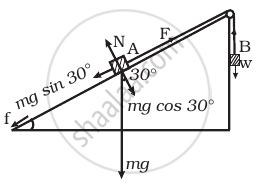
Block A of weight 100 N rests on a frictionless inclined plane of slope angle 30° (figure). A flexible cord attached to A passes over a frictonless pulley and is connected to block B of weight W. Find the weight W for which the system is in equilibrium.
A balloon has mass of 10 g in air. The air escapes from the balloon at a uniform rate with velocity 4.5 cm/s. If the balloon shrinks in 5 s completely. Then, the average force acting on that balloon will be (in dyne).
What is the significance of Newton’s first law?
