Advertisements
Advertisements
प्रश्न
A force F1 acts on a particle accelerating it from rest to a velocity v. Force F1 is then replaced by F2 which decelerates the particle to rest.
विकल्प
F1 must be equal to F2.
F1 may be equal to F2.
F1 must be unequal to F2
Advertisements
उत्तर
F1 may be equal to F2.
Any force applied in the direction opposite the motion of the particle decelerates it to rest.
APPEARS IN
संबंधित प्रश्न
When a carpet is beaten with a stick, dust comes out of it. Explain.
Give the magnitude and direction of the net force acting on a drop of rain falling down with a constant speed.
What is the other name of Newton’s first law of motion ?
Name the physical quantity whose unit is ‘newton’.
Name the law involved in the following situation :
if there were no friction and no air resistance, then a moving bicycle would go on moving for ever.
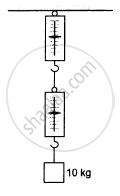
A block of mass 10 kg is suspended from two light spring balances, as shown in the following figure.
Three rigid rods are joined to form an equilateral triangle ABC of side 1 m. Three particles carrying charges 20 μC each are attached to the vertices of the triangle. The whole system is at rest in an inertial frame. The magnitude of the resultant force on the charged particle at A is.
In an imaginary atmosphere, the air exerts a small force F on any particle in the direction of the particle's motion. A particle of mass m projected upward takes time t1 in reaching the maximum height and t2 in the return journey to the original point. Then.
An object of mass 2 kg is sliding with a constant velocity of 4 m/s on a frictionless horizontal table. The force required to keep this object moving with the same velocity is :
Derive the relation between newton and dyne.
Give one example each of inertia of rest and inertia of motion.
The amount of inertia of a body depends on its _________.
A man riding on a car has ___________ Inertia.
Name the scientist who first stated the law of inertia.
Match the following
| Column I | Column II |
| Newton’s I law | propulsion of a rocket |
| Newton’s II law | Stable equilibrium of a body |
| Newton’s III law | Law of force |
| Law of conservation of linear momentum | Flying nature of bird |
When a bus suddenly takes a tum, the passengers are thrown outwards because of
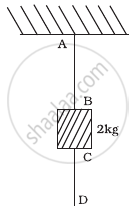
A mass of 2 kg is suspended with thread AB (Figure). Thread CD of the same type is attached to the other end of 2 kg mass. Lower thread is pulled gradually, harder and harder in the downward directon so as to apply force on AB. Which of the threads will break and why?
Two blocks A and B of masses m and 2 m, respectively, are held at rest such that the spring is in natural length. Find out the accelerations of both the blocks just after release.

When does an object accelerate?
