Advertisements
Advertisements
प्रश्न
Name the physical quantity whose unit is ‘newton’.
Advertisements
उत्तर
Force is the physical quantity whose unit is ‘Newton’.
APPEARS IN
संबंधित प्रश्न
If the speed of the stone is increased beyond the maximum permissible value, and the string breaks suddenly, which of the following correctly describes the trajectory of the stone after the string breaks?
It is sometimes heard that the inertial frame of reference is only an ideal concept and no such inertial frame actually exists. Comment.
A particle is found to be at rest when seen from a frame S1 and moving with constant velocity when seen from another frame S2. Mark out the possible options.
(a) Both the frames are inertial.
(b) Both the frames are non-inertial.
(c) S1 is inertial and S2 is non-inertial.
(d) S1 is non-inertial and S2 is inertial
An object of mass 2 kg is sliding with a constant velocity of 4 m/s on a frictionless horizontal table. The force required to keep this object moving with the same velocity is :
State Newton's first law of motion.
Give one example each of inertia of rest and inertia of motion.
The amount of inertia of a body depends on its _________.
A body of mass 10 kg is acted upon by two perpendicular forces, 6 N and 8 N. The resultant acceleration of the body is ______.
- 1 m s–2 at an angle of tan−1 `(4/3)` w.r.t 6 N force.
- 0.2 m s–2 at an angle of tan−1 `(4/3)` w.r.t 6 N force.
- 1 m s–2 at an angle of tan−1 `(3/4)` w.r.t 8 N force.
- 0.2 m s–2 at an angle of tan−1 `(3/4)` w.r.t 8 N force.
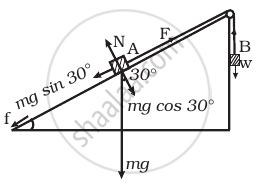
Block A of weight 100 N rests on a frictionless inclined plane of slope angle 30° (figure). A flexible cord attached to A passes over a frictonless pulley and is connected to block B of weight W. Find the weight W for which the system is in equilibrium.
In a legend, the hero-kid kicked a toy pig so that it is projected with a speed greater than that of its cry. If the weight of the toy pig is assumed to be 5 kg and the time of contact 0.01 sec., the force with which the hero-kid kicked him was ______.
(Speed of cry = 330 m/s)
