Advertisements
Advertisements
प्रश्न
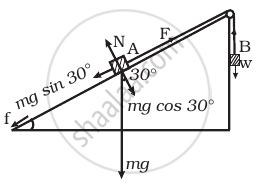
Block A of weight 100 N rests on a frictionless inclined plane of slope angle 30° (figure). A flexible cord attached to A passes over a frictonless pulley and is connected to block B of weight W. Find the weight W for which the system is in equilibrium.
Advertisements
उत्तर
In equilibrium, the force mg sin θ acting on block A parallel to the plane should be balanced by the tension in the string, ie.,
mg sin θ = T = F [∵ T = F given] ......(i)
And for block B, w = T = F ......(ii)
Where w is the weight of block B.
From equations (i) and (ii), we get,
w = mg sin θ
= 100 × sin 30° .....[∵ mg = 100 N]
= `100 xx 1/2` N
= 50 N
APPEARS IN
संबंधित प्रश्न
Give the magnitude and direction of the net force acting on a drop of rain falling down with a constant speed.
A moving bicycle comes to rest after sometime if we stop pedalling it. But Newton’s first law of motion says that a moving body should continue to move for ever, unless some external force acts on it. How do you explain the bicycle case ?
Name the law involved in the following situation :
if there were no friction and no air resistance, then a moving bicycle would go on moving for ever.
Is it possible for a particle to describe a curved path if no force acts on it? Does your answer depend on the frame of reference chosen to view the particle?
A block of mass 10 kg is suspended from two light spring balances, as shown in the following figure.

A force F1 acts on a particle accelerating it from rest to a velocity v. Force F1 is then replaced by F2 which decelerates the particle to rest.
The force exerted by the floor of an elevator on the foot of a person is more than the weight of the person if the elevator is
(a) going up and slowing down
(b) going up and speeding up
(c) going down and slowing down
(d) going down and speeding up
A block of 2 kg is suspended from a ceiling by a massless spring of spring constant k = 100 N/m. What is the elongation of the spring? If another 1 kg is added to the block, what would be the further elongation?
If you jump barefoot on a hard surface, your legs are injured. But they are not injured if you jump on a soft surface like sand or pillow. Why?
How does Newton's second law of motion differ from the first law of motion?
What do you mean by inertia of motion?
The greater is the __________ the greater is the inertia of an object.
The amount of inertia of a body depends on its _________.
Give two examples of the following:
Inertia of rest
Name the scientist who first stated the law of inertia.
Differentiate between gravitational mass and inertial mass.
Classify the types of force based on their application.
In the above given problem if the lower thread is pulled with a jerk, what happens?
In a legend, the hero-kid kicked a toy pig so that it is projected with a speed greater than that of its cry. If the weight of the toy pig is assumed to be 5 kg and the time of contact 0.01 sec., the force with which the hero-kid kicked him was ______.
(Speed of cry = 330 m/s)
