Advertisements
Advertisements
प्रश्न
Name the law involved in the following situation :
if there were no friction and no air resistance, then a moving bicycle would go on moving for ever.
Advertisements
उत्तर
Newton’s first law of motion is involved .
APPEARS IN
संबंधित प्रश्न
State Newton’s first law of motion. Give two examples to illustrate Newton’s first law of motion.
Name the different kinds of inertia an object can possess. Give an example of each.
If a 5 N and a 15 N forces are acting opposite to one another. Find the resultant force and the direction of action of the resultant force.
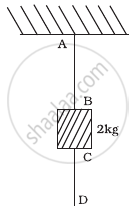
A mass of 2 kg is suspended with thread AB (Figure). Thread CD of the same type is attached to the other end of 2 kg mass. Lower thread is pulled gradually, harder and harder in the downward directon so as to apply force on AB. Which of the threads will break and why?
Two blocks A and B of masses m and 2 m, respectively, are held at rest such that the spring is in natural length. Find out the accelerations of both the blocks just after release.

A balloon has mass of 10 g in air. The air escapes from the balloon at a uniform rate with velocity 4.5 cm/s. If the balloon shrinks in 5 s completely. Then, the average force acting on that balloon will be (in dyne).
What is the significance of Newton’s first law?
If the net force on an object is zero, what happens?
How is force defined according to Newton’s First Law?
An interstellar spacecraft, far away from the influence of any star or planet, is moving at high speed under the influence of fusion rockets (due to the thrust exerted by fusion rockets, the spacecraft is accelerating). Suddenly the engine malfunctions and stops. The spacecraft will ______.
