Advertisements
Advertisements
प्रश्न
If a 5 N and a 15 N forces are acting opposite to one another. Find the resultant force and the direction of action of the resultant force.
Advertisements
उत्तर
The two forces are unlike parallel forces
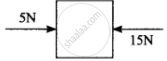
Let P = 5N, Q = 15N
Resultant force (R) = P – Q = 5 + (-15) = -10N
R = -10N.
The resultant force acting along the direction of “Q”.
APPEARS IN
संबंधित प्रश्न
The driver of a three-wheeler moving with a speed of 36 km/h sees a child standing in the middle of the road and brings his vehicle to rest in 4.0 s just in time to save the child. What is the average retarding force on the vehicle? The mass of the three-wheeler is 400 kg and the mass of the driver is 65 kg.
State Newton’s first law of motion. Give two examples to illustrate Newton’s first law of motion.
The acceleration of a particle is zero, as measured from an inertial frame of reference. Can we conclude that no force acts on the particle?
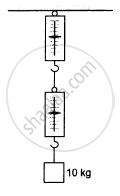
A block of mass 10 kg is suspended from two light spring balances, as shown in the following figure.
A particle stays at rest as seen in a frame. We can conclude that
(a) the frame is inertial
(b) resultant force on the particle is zero
(c) the frame may be inertial but the resultant force on the particle is zero
(d) the frame may be non-inertial but there is a non-zero resultant force
State Newton's first law of motion.
A body of mass 10 kg is acted upon by two perpendicular forces, 6 N and 8 N. The resultant acceleration of the body is ______.
- 1 m s–2 at an angle of tan−1 `(4/3)` w.r.t 6 N force.
- 0.2 m s–2 at an angle of tan−1 `(4/3)` w.r.t 6 N force.
- 1 m s–2 at an angle of tan−1 `(3/4)` w.r.t 8 N force.
- 0.2 m s–2 at an angle of tan−1 `(3/4)` w.r.t 8 N force.
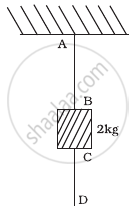
A mass of 2 kg is suspended with thread AB (Figure). Thread CD of the same type is attached to the other end of 2 kg mass. Lower thread is pulled gradually, harder and harder in the downward directon so as to apply force on AB. Which of the threads will break and why?
A smooth sphere of radius R and mass M is placed on the smooth horizontal floor. Another smooth particle of mass m is placed on the sphere and a horizontal force F is applied on the sphere as shown. If the particle does not slip on the sphere then the value of force F is ______.

What does inertia measure in an object?
