Advertisements
Advertisements
Question
If a 5 N and a 15 N forces are acting opposite to one another. Find the resultant force and the direction of action of the resultant force.
Advertisements
Solution
The two forces are unlike parallel forces
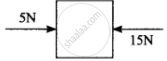
Let P = 5N, Q = 15N
Resultant force (R) = P – Q = 5 + (-15) = -10N
R = -10N.
The resultant force acting along the direction of “Q”.
APPEARS IN
RELATED QUESTIONS
What is the other name of Newton’s first law of motion ?
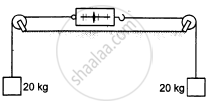
The figure shows a light spring balance connected to two blocks of mass 20 kg each. The graduations in the balance measure the tension in the spring. (a) What is the reading of the balance? (b) Will the reading change if the balance is heavy, say 2.0 kg? (c) What will happen if the spring is light but the blocks have unequal masses?
A particle is found to be at rest when seen from a frame S1 and moving with constant velocity when seen from another frame S2. Mark out the possible options.
(a) Both the frames are inertial.
(b) Both the frames are non-inertial.
(c) S1 is inertial and S2 is non-inertial.
(d) S1 is non-inertial and S2 is inertial
'When a hanging carpet is beaten with a stick, the dust particles start coming out of it'. This phenomenon can be best explained by making use of :
State and explain the law of inertia (or Newton's first law of motion).
Explain the following :
After alighting from a moving bus , one has to run for some distance in the direction of bus in order to avoid falling .
The amount of inertia of a body depends on its _________.
If the net force on an object is zero, what happens?
How is force defined according to Newton’s First Law?
An interstellar spacecraft, far away from the influence of any star or planet, is moving at high speed under the influence of fusion rockets (due to the thrust exerted by fusion rockets, the spacecraft is accelerating). Suddenly the engine malfunctions and stops. The spacecraft will ______.
