Advertisements
Advertisements
Question
What is the other name of Newton’s first law of motion ?
Advertisements
Solution
Newton’s first law of motion is also known as Galileo’s law of inertia.
APPEARS IN
RELATED QUESTIONS
Find the acceleration produced by a force of 5 N acting on a mass of 10 kg.
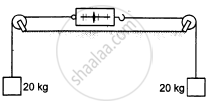
The figure shows a light spring balance connected to two blocks of mass 20 kg each. The graduations in the balance measure the tension in the spring. (a) What is the reading of the balance? (b) Will the reading change if the balance is heavy, say 2.0 kg? (c) What will happen if the spring is light but the blocks have unequal masses?
Neglect the effect of rotation of the earth. Suppose the earth suddenly stops attracting objects placed near its surface. A person standing on the surface of the earth will.
State Newton's first law of motion.
The amount of inertia of a body depends on its _________.
Give two examples of the following:
Inertia of rest
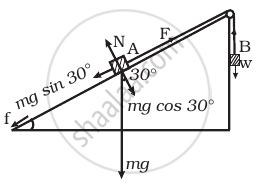
Block A of weight 100 N rests on a frictionless inclined plane of slope angle 30° (figure). A flexible cord attached to A passes over a frictonless pulley and is connected to block B of weight W. Find the weight W for which the system is in equilibrium.
What is the significance of Newton’s first law?
When does an object accelerate?
An insect is at the bottom of a hemispherical ditch of radius 1 m. It crawls up the ditch but starts slipping after it is at height h from the bottom. If the coefficient of friction between the ground and the insect is 0.75, then h is ______. (g = 10 ms−2)
