Advertisements
Advertisements
Question
Find the acceleration produced by a force of 5 N acting on a mass of 10 kg.
Advertisements
Solution
We know that:
Force = mass × acceleration
= m × a
Here, mass, m = 10 kg
force, F = 5 N
Putting these values in the above formula, we get:
5 N = 10 × acceleration
⇒ acceleration = `5/10`
⇒ acceleration = `0.5 "m/s"^2`
APPEARS IN
RELATED QUESTIONS
Give the magnitude and direction of the net force acting on a drop of rain falling down with a constant speed.
The driver of a three-wheeler moving with a speed of 36 km/h sees a child standing in the middle of the road and brings his vehicle to rest in 4.0 s just in time to save the child. What is the average retarding force on the vehicle? The mass of the three-wheeler is 400 kg and the mass of the driver is 65 kg.
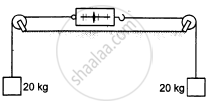
The figure shows a light spring balance connected to two blocks of mass 20 kg each. The graduations in the balance measure the tension in the spring. (a) What is the reading of the balance? (b) Will the reading change if the balance is heavy, say 2.0 kg? (c) What will happen if the spring is light but the blocks have unequal masses?
In an imaginary atmosphere, the air exerts a small force F on any particle in the direction of the particle's motion. A particle of mass m projected upward takes time t1 in reaching the maximum height and t2 in the return journey to the original point. Then.
State Newton's first law of motion.
What do you mean by inertia of motion?
Give one example each of inertia of rest and inertia of motion.
Name the scientist who first stated the law of inertia.
When a bus suddenly takes a tum, the passengers are thrown outwards because of
The masses of 10 kg and 20 kg, respectively, are connected by massless spring as shown in the figure. A force of 200 N acts on the 20 kg mass. At the instant shown, the 10 kg mass has acceleration of 12 m/s2. What is the acceleration of 20 kg mass?
(g = 10 m/s2)

