Advertisements
Advertisements
प्रश्न
Find the acceleration produced by a force of 5 N acting on a mass of 10 kg.
Advertisements
उत्तर
We know that:
Force = mass × acceleration
= m × a
Here, mass, m = 10 kg
force, F = 5 N
Putting these values in the above formula, we get:
5 N = 10 × acceleration
⇒ acceleration = `5/10`
⇒ acceleration = `0.5 "m/s"^2`
APPEARS IN
संबंधित प्रश्न
A reference frame attached to the earth
(a) is an inertial frame by definition
(b) cannot be an inertial frame because the earth is revolving around the sun
(c) is an inertial frame because Newton's laws are applicable in this frame
(d) cannot be an inertial frame because the earth is rotating about its axis.
A particle stays at rest as seen in a frame. We can conclude that
(a) the frame is inertial
(b) resultant force on the particle is zero
(c) the frame may be inertial but the resultant force on the particle is zero
(d) the frame may be non-inertial but there is a non-zero resultant force
A particle is found to be at rest when seen from a frame S1 and moving with constant velocity when seen from another frame S2. Mark out the possible options.
(a) Both the frames are inertial.
(b) Both the frames are non-inertial.
(c) S1 is inertial and S2 is non-inertial.
(d) S1 is non-inertial and S2 is inertial
The force exerted by the floor of an elevator on the foot of a person is more than the weight of the person if the elevator is
(a) going up and slowing down
(b) going up and speeding up
(c) going down and slowing down
(d) going down and speeding up
What do you mean by inertia of motion?
Give one example each of inertia of rest and inertia of motion.
The amount of inertia of a body depends on its _________.
What do you mean by inertia of rest?
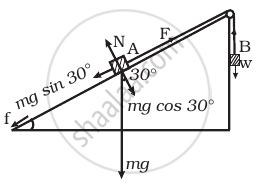
Block A of weight 100 N rests on a frictionless inclined plane of slope angle 30° (figure). A flexible cord attached to A passes over a frictonless pulley and is connected to block B of weight W. Find the weight W for which the system is in equilibrium.
A smooth sphere of radius R and mass M is placed on the smooth horizontal floor. Another smooth particle of mass m is placed on the sphere and a horizontal force F is applied on the sphere as shown. If the particle does not slip on the sphere then the value of force F is ______.

