Advertisements
Advertisements
प्रश्न
'When a hanging carpet is beaten with a stick, the dust particles start coming out of it'. This phenomenon can be best explained by making use of :
विकल्प
Newton's third law of motion
Newton's law of gravitation
Newton's first law of motion
Newton's second law of motion
Advertisements
उत्तर
Newton’s first law of motion
This is because beating the carpet with a stick makes the carpet move to-and-fro quickly, but the dust particles tend to remain at rest due to their inertia and get separated from the carpet.
APPEARS IN
संबंधित प्रश्न
Give the magnitude and direction of the net force acting on a drop of rain falling down with a constant speed.
Fill in the following blank with suitable word :
Newton’s first law of motion is also called Galileo’s law of ………………………
Name the physical quantity whose unit is ‘newton’.
A particle is found to be at rest when seen from a frame S1 and moving with constant velocity when seen from another frame S2. Mark out the possible options.
(a) Both the frames are inertial.
(b) Both the frames are non-inertial.
(c) S1 is inertial and S2 is non-inertial.
(d) S1 is non-inertial and S2 is inertial
The amount of inertia of a body depends on its _________.
Differentiate between gravitational mass and inertial mass.
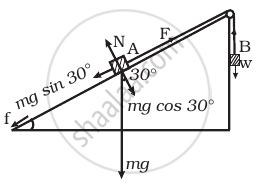
Block A of weight 100 N rests on a frictionless inclined plane of slope angle 30° (figure). A flexible cord attached to A passes over a frictonless pulley and is connected to block B of weight W. Find the weight W for which the system is in equilibrium.
The masses of 10 kg and 20 kg, respectively, are connected by massless spring as shown in the figure. A force of 200 N acts on the 20 kg mass. At the instant shown, the 10 kg mass has acceleration of 12 m/s2. What is the acceleration of 20 kg mass?
(g = 10 m/s2)

A force F is applied to the initially stationary cart. The variation of force with time is shown in the figure. The speed of the cart at t = 5 sec is ______.

What does inertia measure in an object?
