Advertisements
Advertisements
प्रश्न
Give two examples of the following:
Inertia of motion
Advertisements
उत्तर
A ball rolling on the ground will continue to roll unless the external force , the force of friction between the ball and the ground stops it.This is an example of inertia of motion.
APPEARS IN
संबंधित प्रश्न
Define one newton force.
Name the physical quantity whose unit is ‘newton’.
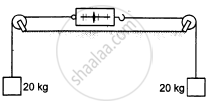
The figure shows a light spring balance connected to two blocks of mass 20 kg each. The graduations in the balance measure the tension in the spring. (a) What is the reading of the balance? (b) Will the reading change if the balance is heavy, say 2.0 kg? (c) What will happen if the spring is light but the blocks have unequal masses?
Neglect the effect of rotation of the earth. Suppose the earth suddenly stops attracting objects placed near its surface. A person standing on the surface of the earth will.
Three rigid rods are joined to form an equilateral triangle ABC of side 1 m. Three particles carrying charges 20 μC each are attached to the vertices of the triangle. The whole system is at rest in an inertial frame. The magnitude of the resultant force on the charged particle at A is.
A force of 600 dynes acts on a glass ball of mass 200 g for 12 s. If initially, the ball is at rest, find
- Final velocity
- Distance covered.
In a legend, the hero-kid kicked a toy pig so that it is projected with a speed greater than that of its cry. If the weight of the toy pig is assumed to be 5 kg and the time of contact 0.01 sec., the force with which the hero-kid kicked him was ______.
(Speed of cry = 330 m/s)
Two blocks A and B of masses m and 2 m, respectively, are held at rest such that the spring is in natural length. Find out the accelerations of both the blocks just after release.

What is the significance of Newton’s first law?
If the net force on an object is zero, what happens?
