Advertisements
Advertisements
प्रश्न
A force of 600 dynes acts on a glass ball of mass 200 g for 12 s. If initially, the ball is at rest, find
- Final velocity
- Distance covered.
Advertisements
उत्तर
F = 600 dyne = 600 g cms−2
m = 200 g
Acceleration = a =`"F"/"m"=(600"gcms"^-2)/(200"g")`
a = 3 cms−2
Also time = t = 12 s
Initial velocity = u = 0
1. Final velocity = v = ?
v = u + at
v = 0 + 3 (12)
v = 36 cms−1
2. Distance covered = S = ?
v2 – w2 = 2a s
(36)2 − (0)2 = 2(3)s
S = `(36xx36)/6` = 36 × 6 = 216 cm
APPEARS IN
संबंधित प्रश्न
A block of mass 10 kg is suspended from two light spring balances, as shown in the following figure.
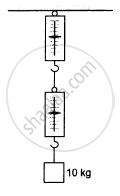
A particle is found to be at rest when seen from a frame S1 and moving with constant velocity when seen from another frame S2. Mark out the possible options.
(a) Both the frames are inertial.
(b) Both the frames are non-inertial.
(c) S1 is inertial and S2 is non-inertial.
(d) S1 is non-inertial and S2 is inertial
A particle is observed from two frames S1 and S2. Frame S2 moves with respect to S1with an acceleration a. Let F1 and F2 be the pseudo forces on the particle when seen from S1 and S2, respectively. Which of the following is not possible?
'When a hanging carpet is beaten with a stick, the dust particles start coming out of it'. This phenomenon can be best explained by making use of :
What do you mean by inertia of motion?
If a 5 N and a 15 N forces are acting opposite to one another. Find the resultant force and the direction of action of the resultant force.
In a legend, the hero-kid kicked a toy pig so that it is projected with a speed greater than that of its cry. If the weight of the toy pig is assumed to be 5 kg and the time of contact 0.01 sec., the force with which the hero-kid kicked him was ______.
(Speed of cry = 330 m/s)
A smooth sphere of radius R and mass M is placed on the smooth horizontal floor. Another smooth particle of mass m is placed on the sphere and a horizontal force F is applied on the sphere as shown. If the particle does not slip on the sphere then the value of force F is ______.

The masses of 10 kg and 20 kg, respectively, are connected by massless spring as shown in the figure. A force of 200 N acts on the 20 kg mass. At the instant shown, the 10 kg mass has acceleration of 12 m/s2. What is the acceleration of 20 kg mass?
(g = 10 m/s2)

An insect is at the bottom of a hemispherical ditch of radius 1 m. It crawls up the ditch but starts slipping after it is at height h from the bottom. If the coefficient of friction between the ground and the insect is 0.75, then h is ______. (g = 10 ms−2)
