Advertisements
Advertisements
प्रश्न
State and explain the law of inertia (or Newton's first law of motion).
Advertisements
उत्तर
Statement of Newton's first law: If a body is in a state of rest, it will remain in the state of rest, and if the body is in the state of motion, it will remain moving in the same direction with the same speed unless an external force is applied on it.
Explanation: Newton's first law can be explained in the following two parts:
(i) Definition of inertia: The 1st part of Newton's first law of motion gives the definition of inertia, according to which an object cannot change its state by itself.
Example: A book lying on a table will remain in its position unless it is displaced.
(ii) Definition of force: The 2nd part of Newton's first law defines force, according to which force is that external cause which can move a stationary object or which can stop a moving object.
Example: A book lying on a table is displaced from its place when it is pushed.
APPEARS IN
संबंधित प्रश्न
Name the scientist who gave the laws of motion.
A moving bicycle comes to rest after sometime if we stop pedalling it. But Newton’s first law of motion says that a moving body should continue to move for ever, unless some external force acts on it. How do you explain the bicycle case ?
Define one newton force.
A plumb bob is hung from the ceiling of a train compartment. If the train moves with an acceleration 'a' along a straight horizontal track , the string supporting the bob makes an angle tan−1 (a/g) with the normal to the ceiling. Suppose the train moves on an inclined straight track with uniform velocity. If the angle of incline is tan−1 (a/g), the string again makes the same angle with the normal to the ceiling. Can a person sitting inside the compartment tell by looking at the plumb line whether the train is accelerating on a horizontal straight track or moving on an incline? If yes, how? If not, then suggest a method to do so.
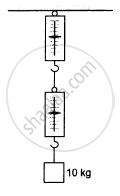
A block of mass 10 kg is suspended from two light spring balances, as shown in the following figure.
Name the different kinds of inertia an object can possess. Give an example of each.
What do you mean by inertia of rest?
Newton's first law of motion describes ______.
What does inertia measure in an object?
An insect is at the bottom of a hemispherical ditch of radius 1 m. It crawls up the ditch but starts slipping after it is at height h from the bottom. If the coefficient of friction between the ground and the insect is 0.75, then h is ______. (g = 10 ms−2)
