Advertisements
Advertisements
प्रश्न
A plumb bob is hung from the ceiling of a train compartment. If the train moves with an acceleration 'a' along a straight horizontal track , the string supporting the bob makes an angle tan−1 (a/g) with the normal to the ceiling. Suppose the train moves on an inclined straight track with uniform velocity. If the angle of incline is tan−1 (a/g), the string again makes the same angle with the normal to the ceiling. Can a person sitting inside the compartment tell by looking at the plumb line whether the train is accelerating on a horizontal straight track or moving on an incline? If yes, how? If not, then suggest a method to do so.
Advertisements
उत्तर
No, a person sitting inside the compartment can't tell just by looking at the plumb line whether the train is accelerating on a horizontal straight track or moving on an incline.
When the train is accelerating along the horizontal, the tension in the string is \[m\sqrt{g^2 + a^2}\] when it is moving on the inclined plane, the tension is mg. So, by measuring the tension in the string we can differentiate between the two cases.
APPEARS IN
संबंधित प्रश्न
If the speed of the stone is increased beyond the maximum permissible value, and the string breaks suddenly, which of the following correctly describes the trajectory of the stone after the string breaks?
Name the scientist who gave the laws of motion.
Name the law involved in the following situation :
if there were no friction and no air resistance, then a moving bicycle would go on moving for ever.
It is sometimes heard that the inertial frame of reference is only an ideal concept and no such inertial frame actually exists. Comment.
The acceleration of a particle is zero, as measured from an inertial frame of reference. Can we conclude that no force acts on the particle?
A particle stays at rest as seen in a frame. We can conclude that
(a) the frame is inertial
(b) resultant force on the particle is zero
(c) the frame may be inertial but the resultant force on the particle is zero
(d) the frame may be non-inertial but there is a non-zero resultant force
A particle is found to be at rest when seen from a frame S1 and moving with constant velocity when seen from another frame S2. Mark out the possible options.
(a) Both the frames are inertial.
(b) Both the frames are non-inertial.
(c) S1 is inertial and S2 is non-inertial.
(d) S1 is non-inertial and S2 is inertial
When a train starts, the head of a standing passenger seems to be pushed backward. Analyse the situation from the ground frame. Does it really go backward? Coming back to the train frame, how do you explain the backward movement of the head on the basis of Newton's laws?
'When a hanging carpet is beaten with a stick, the dust particles start coming out of it'. This phenomenon can be best explained by making use of :
A force of 600 dynes acts on a glass ball of mass 200 g for 12 s. If initially, the ball is at rest, find
- Final velocity
- Distance covered.
Derive the relation between newton and dyne.
The amount of inertia of a body depends on its _________.
What do you mean by inertia of rest?
A body of mass 10 kg is acted upon by two perpendicular forces, 6 N and 8 N. The resultant acceleration of the body is ______.
- 1 m s–2 at an angle of tan−1 `(4/3)` w.r.t 6 N force.
- 0.2 m s–2 at an angle of tan−1 `(4/3)` w.r.t 6 N force.
- 1 m s–2 at an angle of tan−1 `(3/4)` w.r.t 8 N force.
- 0.2 m s–2 at an angle of tan−1 `(3/4)` w.r.t 8 N force.
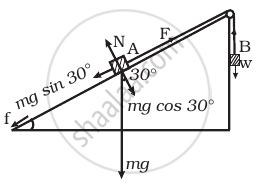
Block A of weight 100 N rests on a frictionless inclined plane of slope angle 30° (figure). A flexible cord attached to A passes over a frictonless pulley and is connected to block B of weight W. Find the weight W for which the system is in equilibrium.
A smooth sphere of radius R and mass M is placed on the smooth horizontal floor. Another smooth particle of mass m is placed on the sphere and a horizontal force F is applied on the sphere as shown. If the particle does not slip on the sphere then the value of force F is ______.

When does an object accelerate?
