Advertisements
Advertisements
Question
A plumb bob is hung from the ceiling of a train compartment. If the train moves with an acceleration 'a' along a straight horizontal track , the string supporting the bob makes an angle tan−1 (a/g) with the normal to the ceiling. Suppose the train moves on an inclined straight track with uniform velocity. If the angle of incline is tan−1 (a/g), the string again makes the same angle with the normal to the ceiling. Can a person sitting inside the compartment tell by looking at the plumb line whether the train is accelerating on a horizontal straight track or moving on an incline? If yes, how? If not, then suggest a method to do so.
Advertisements
Solution
No, a person sitting inside the compartment can't tell just by looking at the plumb line whether the train is accelerating on a horizontal straight track or moving on an incline.
When the train is accelerating along the horizontal, the tension in the string is \[m\sqrt{g^2 + a^2}\] when it is moving on the inclined plane, the tension is mg. So, by measuring the tension in the string we can differentiate between the two cases.
APPEARS IN
RELATED QUESTIONS
A batsman hits a cricket ball which then rolls on a level ground. After covering a short distance, the ball comes to rest. The ball slows to a stop because ______.
Fill in the following blank with suitable word :
Newton’s first law of motion is also called Galileo’s law of ………………………
A moving bicycle comes to rest after sometime if we stop pedalling it. But Newton’s first law of motion says that a moving body should continue to move for ever, unless some external force acts on it. How do you explain the bicycle case ?
Define one newton force.
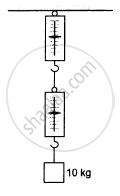
A block of mass 10 kg is suspended from two light spring balances, as shown in the following figure.
A block of 2 kg is suspended from a ceiling by a massless spring of spring constant k = 100 N/m. What is the elongation of the spring? If another 1 kg is added to the block, what would be the further elongation?
When a train starts, the head of a standing passenger seems to be pushed backward. Analyse the situation from the ground frame. Does it really go backward? Coming back to the train frame, how do you explain the backward movement of the head on the basis of Newton's laws?
State Newton's first law of motion.
Give qualitative definition of force on the basic of Newton's first law of motion.
What do you mean by inertia of motion?
A man riding on a car has ___________ Inertia.
Match the following
| Column I | Column II |
| Newton’s I law | propulsion of a rocket |
| Newton’s II law | Stable equilibrium of a body |
| Newton’s III law | Law of force |
| Law of conservation of linear momentum | Flying nature of bird |
If a 5 N and a 15 N forces are acting opposite to one another. Find the resultant force and the direction of action of the resultant force.
A smooth sphere of radius R and mass M is placed on the smooth horizontal floor. Another smooth particle of mass m is placed on the sphere and a horizontal force F is applied on the sphere as shown. If the particle does not slip on the sphere then the value of force F is ______.

A balloon has mass of 10 g in air. The air escapes from the balloon at a uniform rate with velocity 4.5 cm/s. If the balloon shrinks in 5 s completely. Then, the average force acting on that balloon will be (in dyne).
What is the significance of Newton’s first law?
What does inertia measure in an object?
