Advertisements
Advertisements
Question
A block of 2 kg is suspended from a ceiling by a massless spring of spring constant k = 100 N/m. What is the elongation of the spring? If another 1 kg is added to the block, what would be the further elongation?
Advertisements
Solution
Given,
mass of the first block, m = 2 kg
k = 100 N/m
Let elongation in the spring be x. 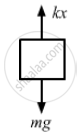
From the free-body diagram,
kx = mg
\[x = \frac{mg}{k} = \frac{2 \times 9 . 8}{100}\]
\[ = \frac{19 . 6}{100} = 0 . 196 \approx 0 . 2 m\]
Suppose, further elongation, when the 1 kg block is added, is \[∆ x\] Then, \[k\left( x + ∆ x \right) = m'g\]
⇒ k \[∆ x\] 3g − 2g = g
\[\Rightarrow ∆ x = \frac{g}{k} = \frac{9 . 8}{100} = 0 . 098 \approx 0 . 1 m\]
APPEARS IN
RELATED QUESTIONS
Name the scientist who gave the laws of motion.
Fill in the following blank with suitable word :
Newton’s first law of motion is also called Galileo’s law of ………………………
A moving bicycle comes to rest after sometime if we stop pedalling it. But Newton’s first law of motion says that a moving body should continue to move for ever, unless some external force acts on it. How do you explain the bicycle case ?
Define one newton force.
Find the acceleration produced by a force of 5 N acting on a mass of 10 kg.
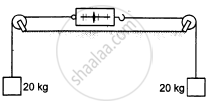
The figure shows a light spring balance connected to two blocks of mass 20 kg each. The graduations in the balance measure the tension in the spring. (a) What is the reading of the balance? (b) Will the reading change if the balance is heavy, say 2.0 kg? (c) What will happen if the spring is light but the blocks have unequal masses?
The acceleration of a particle is zero, as measured from an inertial frame of reference. Can we conclude that no force acts on the particle?
Consider a book lying on a table. The weight of the book and the normal force by the table in the book are equal in magnitude and opposite in direction. Is this an example of Newton's third law?
Three rigid rods are joined to form an equilateral triangle ABC of side 1 m. Three particles carrying charges 20 μC each are attached to the vertices of the triangle. The whole system is at rest in an inertial frame. The magnitude of the resultant force on the charged particle at A is.
A block of mass 2 kg placed on a long frictionless horizontal table is pulled horizontally by a constant force F. It is found to move 10 m in the first seconds. Find the magnitude of F.
What do you mean by inertia of motion?
Name the different kinds of inertia an object can possess. Give an example of each.
The amount of inertia of a body depends on its _________.
Give two examples of the following:
Inertia of rest
Give two examples of the following:
Inertia of motion
If a 5 N and a 15 N forces are acting opposite to one another. Find the resultant force and the direction of action of the resultant force.
When a bus suddenly takes a tum, the passengers are thrown outwards because of
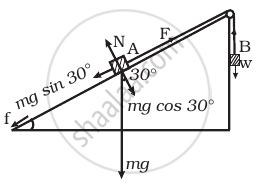
Block A of weight 100 N rests on a frictionless inclined plane of slope angle 30° (figure). A flexible cord attached to A passes over a frictonless pulley and is connected to block B of weight W. Find the weight W for which the system is in equilibrium.
If the net force on an object is zero, what happens?
How is force defined according to Newton’s First Law?
