Advertisements
Advertisements
Question
Name the physical quantity whose unit is ‘newton’.
Advertisements
Solution
Force is the physical quantity whose unit is ‘Newton’.
APPEARS IN
RELATED QUESTIONS
When a carpet is beaten with a stick, dust comes out of it. Explain.
If the speed of the stone is increased beyond the maximum permissible value, and the string breaks suddenly, which of the following correctly describes the trajectory of the stone after the string breaks?
Name the scientist who gave the laws of motion.
The acceleration of a particle is zero, as measured from an inertial frame of reference. Can we conclude that no force acts on the particle?
Three rigid rods are joined to form an equilateral triangle ABC of side 1 m. Three particles carrying charges 20 μC each are attached to the vertices of the triangle. The whole system is at rest in an inertial frame. The magnitude of the resultant force on the charged particle at A is.
Newton's first law of motion describes ______.
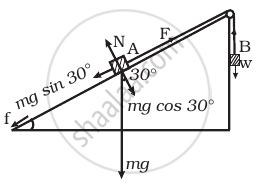
Block A of weight 100 N rests on a frictionless inclined plane of slope angle 30° (figure). A flexible cord attached to A passes over a frictonless pulley and is connected to block B of weight W. Find the weight W for which the system is in equilibrium.
A force F is applied to the initially stationary cart. The variation of force with time is shown in the figure. The speed of the cart at t = 5 sec is ______.

This question has Statement 1 and Statement 2. Of the four choices given after the Statements, choose the one that best describes the two Statements.
Statement 1: If you push on a cart being pulled by a horse so that it does not move, the cart pushes you back with an equal and opposite force.
Statement 2: The cart does not move because the force described in statement 1 cancel each other.
An interstellar spacecraft, far away from the influence of any star or planet, is moving at high speed under the influence of fusion rockets (due to the thrust exerted by fusion rockets, the spacecraft is accelerating). Suddenly the engine malfunctions and stops. The spacecraft will ______.
