Advertisements
Advertisements
Question
When a carpet is beaten with a stick, dust comes out of it. Explain.
Advertisements
Solution
- The inertia of an object tends to resist any change in its state of rest or state of motion.
- When a carpet is beaten with a stick, then the carpet comes into motion. But the dust particles try to resist their state of rest.
- According to Newton’s first law of motion, the dust particles stay in a state of rest while the carpet moves. Hence, the dust particles come out of the carpet.
RELATED QUESTIONS
A moving bicycle comes to rest after sometime if we stop pedalling it. But Newton’s first law of motion says that a moving body should continue to move for ever, unless some external force acts on it. How do you explain the bicycle case ?
A plumb bob is hung from the ceiling of a train compartment. If the train moves with an acceleration 'a' along a straight horizontal track , the string supporting the bob makes an angle tan−1 (a/g) with the normal to the ceiling. Suppose the train moves on an inclined straight track with uniform velocity. If the angle of incline is tan−1 (a/g), the string again makes the same angle with the normal to the ceiling. Can a person sitting inside the compartment tell by looking at the plumb line whether the train is accelerating on a horizontal straight track or moving on an incline? If yes, how? If not, then suggest a method to do so.
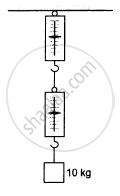
A block of mass 10 kg is suspended from two light spring balances, as shown in the following figure.
If you jump barefoot on a hard surface, your legs are injured. But they are not injured if you jump on a soft surface like sand or pillow. Why?
'When a hanging carpet is beaten with a stick, the dust particles start coming out of it'. This phenomenon can be best explained by making use of :
The amount of inertia of a body depends on its _________.
Give two examples of the following:
Inertia of rest
Match the following
| Column I | Column II |
| Newton’s I law | propulsion of a rocket |
| Newton’s II law | Stable equilibrium of a body |
| Newton’s III law | Law of force |
| Law of conservation of linear momentum | Flying nature of bird |
Classify the types of force based on their application.
An insect is at the bottom of a hemispherical ditch of radius 1 m. It crawls up the ditch but starts slipping after it is at height h from the bottom. If the coefficient of friction between the ground and the insect is 0.75, then h is ______. (g = 10 ms−2)
