Advertisements
Advertisements
प्रश्न
A block of 2 kg is suspended from a ceiling by a massless spring of spring constant k = 100 N/m. What is the elongation of the spring? If another 1 kg is added to the block, what would be the further elongation?
Advertisements
उत्तर
Given,
mass of the first block, m = 2 kg
k = 100 N/m
Let elongation in the spring be x. 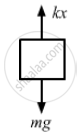
From the free-body diagram,
kx = mg
\[x = \frac{mg}{k} = \frac{2 \times 9 . 8}{100}\]
\[ = \frac{19 . 6}{100} = 0 . 196 \approx 0 . 2 m\]
Suppose, further elongation, when the 1 kg block is added, is \[∆ x\] Then, \[k\left( x + ∆ x \right) = m'g\]
⇒ k \[∆ x\] 3g − 2g = g
\[\Rightarrow ∆ x = \frac{g}{k} = \frac{9 . 8}{100} = 0 . 098 \approx 0 . 1 m\]
APPEARS IN
संबंधित प्रश्न
Fill in the following blank with suitable word :
Newton’s first law of motion is also called Galileo’s law of ………………………
Define one newton force.
Find the acceleration produced by a force of 5 N acting on a mass of 10 kg.
Name the law involved in the following situation :
if there were no friction and no air resistance, then a moving bicycle would go on moving for ever.
The acceleration of a particle is zero, as measured from an inertial frame of reference. Can we conclude that no force acts on the particle?
Consider a book lying on a table. The weight of the book and the normal force by the table in the book are equal in magnitude and opposite in direction. Is this an example of Newton's third law?
Neglect the effect of rotation of the earth. Suppose the earth suddenly stops attracting objects placed near its surface. A person standing on the surface of the earth will.
A particle is found to be at rest when seen from a frame S1 and moving with constant velocity when seen from another frame S2. Mark out the possible options.
(a) Both the frames are inertial.
(b) Both the frames are non-inertial.
(c) S1 is inertial and S2 is non-inertial.
(d) S1 is non-inertial and S2 is inertial
A force of 600 dynes acts on a glass ball of mass 200 g for 12 s. If initially, the ball is at rest, find
- Final velocity
- Distance covered.
Name the different kinds of inertia an object can possess. Give an example of each.
Name the scientist who first stated the law of inertia.
Differentiate between gravitational mass and inertial mass.
Classify the types of force based on their application.
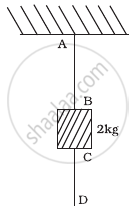
A mass of 2 kg is suspended with thread AB (Figure). Thread CD of the same type is attached to the other end of 2 kg mass. Lower thread is pulled gradually, harder and harder in the downward directon so as to apply force on AB. Which of the threads will break and why?
Two blocks A and B of masses m and 2 m, respectively, are held at rest such that the spring is in natural length. Find out the accelerations of both the blocks just after release.

The masses of 10 kg and 20 kg, respectively, are connected by massless spring as shown in the figure. A force of 200 N acts on the 20 kg mass. At the instant shown, the 10 kg mass has acceleration of 12 m/s2. What is the acceleration of 20 kg mass?
(g = 10 m/s2)

A balloon has mass of 10 g in air. The air escapes from the balloon at a uniform rate with velocity 4.5 cm/s. If the balloon shrinks in 5 s completely. Then, the average force acting on that balloon will be (in dyne).
If the net force on an object is zero, what happens?
How is force defined according to Newton’s First Law?
