Advertisements
Advertisements
प्रश्न
A block of mass 2 kg placed on a long frictionless horizontal table is pulled horizontally by a constant force F. It is found to move 10 m in the first seconds. Find the magnitude of F.
Advertisements
उत्तर
Given:
Mass of the block, m = 2 kg,
Distance covered, S = 10 m and initial velocity, u = 0
t = 2
Formula:
`S = ut + 1/2at^2`
F = ma
Solution:
Let a be the acceleration of the block.
`S = ut + 1/2at^2`
`10 = 1/2a(2^2)` (∵ u = 0)
∴ `a = (10 xx 2)/(2^2)`
∴ `a = (10 xx 2)/(2 xx 2)`
∴ `a = 20/4`
∴ a = 5
Force, F = ma
= 2 × 5
= 10 N
APPEARS IN
संबंधित प्रश्न
When a carpet is beaten with a stick, dust comes out of it. Explain.
State Newton’s first law of motion. Give two examples to illustrate Newton’s first law of motion.
Name the physical quantity whose unit is ‘newton’.
Find the acceleration produced by a force of 5 N acting on a mass of 10 kg.
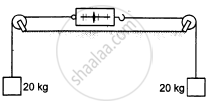
The figure shows a light spring balance connected to two blocks of mass 20 kg each. The graduations in the balance measure the tension in the spring. (a) What is the reading of the balance? (b) Will the reading change if the balance is heavy, say 2.0 kg? (c) What will happen if the spring is light but the blocks have unequal masses?
A reference frame attached to the earth
(a) is an inertial frame by definition
(b) cannot be an inertial frame because the earth is revolving around the sun
(c) is an inertial frame because Newton's laws are applicable in this frame
(d) cannot be an inertial frame because the earth is rotating about its axis.
A particle is observed from two frames S1 and S2. Frame S2 moves with respect to S1with an acceleration a. Let F1 and F2 be the pseudo forces on the particle when seen from S1 and S2, respectively. Which of the following is not possible?
When a train starts, the head of a standing passenger seems to be pushed backward. Analyse the situation from the ground frame. Does it really go backward? Coming back to the train frame, how do you explain the backward movement of the head on the basis of Newton's laws?
'When a hanging carpet is beaten with a stick, the dust particles start coming out of it'. This phenomenon can be best explained by making use of :
State and explain the law of inertia (or Newton's first law of motion).
How does Newton's second law of motion differ from the first law of motion?
What do you mean by inertia of motion?
Give one example each of inertia of rest and inertia of motion.
Name the scientist who first stated the law of inertia.
A car of mass m starts from rest and acquires a velocity along east `v = vhati (v > 0)` in two seconds. Assuming the car moves with uniform acceleration, the force exerted on the car is ______.
This question has Statement 1 and Statement 2. Of the four choices given after the Statements, choose the one that best describes the two Statements.
Statement 1: If you push on a cart being pulled by a horse so that it does not move, the cart pushes you back with an equal and opposite force.
Statement 2: The cart does not move because the force described in statement 1 cancel each other.
Match the following.
| Column I | Column II |
| a. Newton’s I law | propulsion of a rocket |
| b. Newton’s II law | Stable equilibrium of the body |
| c. Newton’s III law | Law of force |
| d. Law of conservation of Linear momentum | Flying nature of bird |
What is the significance of Newton’s first law?
