Advertisements
Advertisements
प्रश्न
A block of mass 2 kg placed on a long frictionless horizontal table is pulled horizontally by a constant force F. It is found to move 10 m in the first seconds. Find the magnitude of F.
Advertisements
उत्तर
Given:
Mass of the block, m = 2 kg,
Distance covered, S = 10 m and initial velocity, u = 0
t = 2
Formula:
`S = ut + 1/2at^2`
F = ma
Solution:
Let a be the acceleration of the block.
`S = ut + 1/2at^2`
`10 = 1/2a(2^2)` (∵ u = 0)
∴ `a = (10 xx 2)/(2^2)`
∴ `a = (10 xx 2)/(2 xx 2)`
∴ `a = 20/4`
∴ a = 5
Force, F = ma
= 2 × 5
= 10 N
APPEARS IN
संबंधित प्रश्न
Name the law involved in the following situation :
if there were no friction and no air resistance, then a moving bicycle would go on moving for ever.
It is sometimes heard that the inertial frame of reference is only an ideal concept and no such inertial frame actually exists. Comment.
Consider a book lying on a table. The weight of the book and the normal force by the table in the book are equal in magnitude and opposite in direction. Is this an example of Newton's third law?
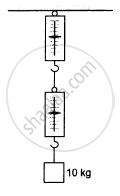
A block of mass 10 kg is suspended from two light spring balances, as shown in the following figure.
In an imaginary atmosphere, the air exerts a small force F on any particle in the direction of the particle's motion. A particle of mass m projected upward takes time t1 in reaching the maximum height and t2 in the return journey to the original point. Then.
A particle is observed from two frames S1 and S2. Frame S2 moves with respect to S1with an acceleration a. Let F1 and F2 be the pseudo forces on the particle when seen from S1 and S2, respectively. Which of the following is not possible?
If you jump barefoot on a hard surface, your legs are injured. But they are not injured if you jump on a soft surface like sand or pillow. Why?
'When a hanging carpet is beaten with a stick, the dust particles start coming out of it'. This phenomenon can be best explained by making use of :
Explain the following :
After alighting from a moving bus , one has to run for some distance in the direction of bus in order to avoid falling .
A force of 600 dynes acts on a glass ball of mass 200 g for 12 s. If initially, the ball is at rest, find
- Final velocity
- Distance covered.
Derive the relation between newton and dyne.
A car of mass m starts from rest and acquires a velocity along east `v = vhati (v > 0)` in two seconds. Assuming the car moves with uniform acceleration, the force exerted on the car is ______.
A mass of 2 kg is suspended with thread AB (Figure). Thread CD of the same type is attached to the other end of 2 kg mass. Lower thread is pulled gradually, harder and harder in the downward directon so as to apply force on AB. Which of the threads will break and why?
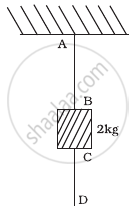
In the above given problem if the lower thread is pulled with a jerk, what happens?
Match the following.
| Column I | Column II |
| a. Newton’s I law | propulsion of a rocket |
| b. Newton’s II law | Stable equilibrium of the body |
| c. Newton’s III law | Law of force |
| d. Law of conservation of Linear momentum | Flying nature of bird |
What is the significance of Newton’s first law?
What does inertia measure in an object?
When does an object accelerate?
