Advertisements
Advertisements
प्रश्न
A car of mass m starts from rest and acquires a velocity along east `v = vhati (v > 0)` in two seconds. Assuming the car moves with uniform acceleration, the force exerted on the car is ______.
विकल्प
`(mv)/2` eastward and is exerted by the car engine.
`(mv)/2` eastward and is due to the friction on the tyres exerted by the road.
more than `(mv)/2` eastward exerted due to the engine and overcomes the friction of the road.
`(mv)/2` exerted by the engine.
Advertisements
उत्तर
A car of mass m starts from rest and acquires a velocity along east `v = vhati (v > 0)` in two seconds. Assuming the car moves with uniform acceleration, the force exerted on the car is `underline((mv)/2)` eastward and is due to the friction on the tyres exerted by the road.
Explanation:
Given, the mass of the car = m
As the car starts from rest, u = 0
Velocity acquired along east = `vhati`
Duration = t = 2s.
We know that v = u + at
⇒ `vhati = o + a xx 2`
⇒ `s = v/2 hati`
Force, F = ma = `(mv)/2 hati`
Hence, the force acting on the car is `(mv)/2` towards the east. As the external force on the system is only friction hence, the force `(mv)/2` is by friction. Hence, force by the engine is internal force.
APPEARS IN
संबंधित प्रश्न
When a carpet is beaten with a stick, dust comes out of it. Explain.
What is the other name of Newton’s first law of motion ?
State Newton’s first law of motion. Give two examples to illustrate Newton’s first law of motion.
Define one newton force.
Name the physical quantity whose unit is ‘newton’.
The acceleration of a particle is zero, as measured from an inertial frame of reference. Can we conclude that no force acts on the particle?
Consider a book lying on a table. The weight of the book and the normal force by the table in the book are equal in magnitude and opposite in direction. Is this an example of Newton's third law?
Neglect the effect of rotation of the earth. Suppose the earth suddenly stops attracting objects placed near its surface. A person standing on the surface of the earth will.
A particle is found to be at rest when seen from a frame S1 and moving with constant velocity when seen from another frame S2. Mark out the possible options.
(a) Both the frames are inertial.
(b) Both the frames are non-inertial.
(c) S1 is inertial and S2 is non-inertial.
(d) S1 is non-inertial and S2 is inertial
A block of 2 kg is suspended from a ceiling by a massless spring of spring constant k = 100 N/m. What is the elongation of the spring? If another 1 kg is added to the block, what would be the further elongation?
How does Newton's second law of motion differ from the first law of motion?
Name the different kinds of inertia an object can possess. Give an example of each.
Match the following
| Column I | Column II |
| Newton’s I law | propulsion of a rocket |
| Newton’s II law | Stable equilibrium of a body |
| Newton’s III law | Law of force |
| Law of conservation of linear momentum | Flying nature of bird |
When a bus suddenly takes a tum, the passengers are thrown outwards because of
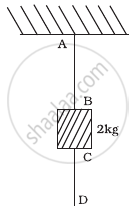
A mass of 2 kg is suspended with thread AB (Figure). Thread CD of the same type is attached to the other end of 2 kg mass. Lower thread is pulled gradually, harder and harder in the downward directon so as to apply force on AB. Which of the threads will break and why?
In a legend, the hero-kid kicked a toy pig so that it is projected with a speed greater than that of its cry. If the weight of the toy pig is assumed to be 5 kg and the time of contact 0.01 sec., the force with which the hero-kid kicked him was ______.
(Speed of cry = 330 m/s)
Two blocks A and B of masses m and 2 m, respectively, are held at rest such that the spring is in natural length. Find out the accelerations of both the blocks just after release.

A force F is applied to the initially stationary cart. The variation of force with time is shown in the figure. The speed of the cart at t = 5 sec is ______.

How is force defined according to Newton’s First Law?
An insect is at the bottom of a hemispherical ditch of radius 1 m. It crawls up the ditch but starts slipping after it is at height h from the bottom. If the coefficient of friction between the ground and the insect is 0.75, then h is ______. (g = 10 ms−2)
