Advertisements
Advertisements
प्रश्न
The motion of a particle of mass m is given by x = 0 for t < 0 s, x(t) = A sin 4 pt for 0 < t < (1/4) s (A > o), and x = 0 for t > (1/4) s. Which of the following statements is true?
- The force at t = (1/8) s on the particle is – 16π2 Am.
- The particle is acted upon by on impulse of magnitude 4π2 A m at t = 0 s and t = (1/4) s.
- The particle is not acted upon by any force.
- The particle is not acted upon by a constant force.
- There is no impulse acting on the particle.
Advertisements
उत्तर
a, b and d
Explanation:
Given, `x = 0` for `t < 0 s`.
`x(t) = A sin 4pit`; for `0 < t < 1/4 s`
`x = 0`; for `t > 1/4 s`
For, `0 < t < 1/4 s`
`v(t) = (dx)/(dt) = 4π A cos 4πt`
`a(t)` = acceleration
= `(dv(t))/(dt)`
= – 16π2 A sin 4 πt
At `t = 1/8 s, a(t) = - 16 π^2 A sin 4π xx 1/8 = - 16π^2 A`
`F = ma (t) = - 16 π^2` A × m = `- 16 π^2` mA
Impulse = Change in linear momentum
= `F xx t = (- 16 π^2 Am) xx 1/4`
= `- 4π^2 Am`
The impulse (Change in linear momentum) at t = 0 is the same as, t = `1/4 s`.
Clearly, force depends upon A which is not constant. Hence, force is also not constant.
APPEARS IN
संबंधित प्रश्न
Two blocks of equal mass m are tied to each other through a light string. One of the blocks is pulled along the line joining them with a constant force F. Find the tension in the string joining the blocks.
A particle of mass 0.3 kg is subjected to a force F = −kx with k = 15 N/m. What will be its initial acceleration if it is released from a point x = 20 cm?
A person is standing on a weighing machine placed on the floor of an elevator. The elevator starts going up with some acceleration, moves with uniform velocity for a while and finally decelerates to stop. The maximum and the minimum weights recorded are 72 kg and 60 kg, respectively. Assuming that the magnitudes of acceleration and deceleration are the same, find (a) the true weight of the person and (b) the magnitude of the acceleration. Take g = 9.9 m/s2.
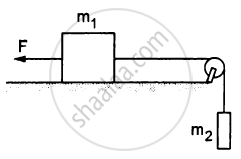
A constant force F = m2g/2 is applied on the block of mass m1 as shown in the following figure. The string and the pulley are light and the surface of the table is smooth. Find the acceleration of m1.
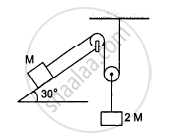
Find the acceleration of the block of mass M in the situation shown in the following figure. All the surfaces are frictionless and the pulleys and the string are light.
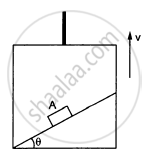
A block A can slide on a frictionless incline of angle θ and length l, kept inside an elevator going up with uniform velocity v in the following figure. Find the time taken by the block to slide down the length of the incline if it is released from the top of the incline.
A block is kept on the floor of an elevator at rest. The elevator starts descending with an acceleration of 12 m/s2. Find the displacement of the block during the first 0.2 s after the start. Take g = 10 m/s2.
An aeroplane is moving uniformly at a constant height under the action of two forces (i) Upward force (lift) and (ii) Downward force (weight). What is the net force on the aeroplane?
Show that the rate of change of momentum = mass × acceleration. Under what condition does this relation hold?
State the magnitude and direction of the force of gravity acting on the body of mass 5 kg. Take g = 9.8 m s-2.
A ball is thrown vertically upwards. It returns 6 s later. Calculate the greatest height reached by the ball. (Take g = 10 m s−2)
An electron of mass 9 × 10⁻³¹ kg is moving with a linear velocity of 6 × 10⁷ ms−1. Calculate the linear momentum of electron.
Multiple Choice Question. Select the correct option.
Which of the following are vector quantities?
What do you mean by linear momentum of a body? A force causes an acceleration of 10 ms-2 in a body of mass 1 kg. What acceleration will be caused by the same force in a body of mass 4 kg?
Use Newton's second law to explain the following:
While catching a fast moving ball, we always pull our hands backwards.
A metre scale is moving with uniform velocity. This implies ______.
In the previous problem (5.3), the magnitude of the momentum transferred during the hit is ______.
A hockey player is moving northward and suddenly turns westward with the same speed to avoid an opponent. The force that acts on the player is ______.
How does moving your hand backward while catching a cricket ball reduce pain?
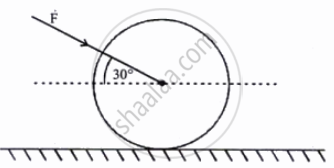
As shown in figure, a 70 kg garden roller is pushed with a force of F = 200 N at an angle of 30° with horizontal. The normal reaction on the roller is: (Given: g = 10 ms−2)