Advertisements
Advertisements
प्रश्न
Two balls A and B of masses m and 2 m are in motion with velocities 2v and v, respectively. Compare:
(i) Their inertia.
(ii) Their momentum.
(iii) The force needed to stop them in the same time.
Advertisements
उत्तर
(i) Inertia of body A:Inertia of body B :: m:2m
Or, Inertia of body A:Inertia of body B :: 1:2.
(ii) Momentum of body A = m (2v) = 2mv
Momentum of body B = (2m) v = 2mv
Momentum of body A:Momentum of body B :: 2 mv:2mv
Or, Momentum of body A:Momentum of body B :: 1:1.
(iii) According to Newton's 2nd law of motion, rate of change of momentum is directly proportional to the force applied on it. Therefore,
Force needed to stop A:Force needed to stop B :: 1:1.
APPEARS IN
संबंधित प्रश्न
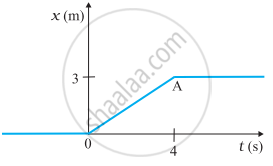
The below figure shows the position-time graph of a particle of mass 4 kg.
- What is the force on the particle for t < 0, t > 4 s, 0 < t < 4 s?
- What is the impulse at t = 0 and t = 4 s? (Consider one-dimensional motion only.)
Two blocks of equal mass m are tied to each other through a light string. One of the blocks is pulled along the line joining them with a constant force F. Find the tension in the string joining the blocks.
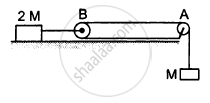
Consider the situation shown in the following figure. Both the pulleys and the string are light and all the surfaces are frictionless.
- Find the acceleration of the mass M.
- Find the tension in the string.
- Calculate the force exerted by the clamp on the pulley A in the figure.
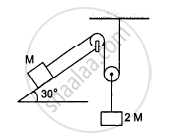
Find the acceleration of the block of mass M in the situation shown in the following figure. All the surfaces are frictionless and the pulleys and the string are light.
Use Newton's second law of motion to explain the following instance :
A cricketer pulls his hands back while catching a fast moving cricket ball .
A motorcycle of mass 100 kg is running at 10 ms−1. If its engine develops an extra linear momentum of 2000 Ns, calculate the new velocity of a motorcycle.
Prove mathematically F = ma
Name the physical quantity which equals the rate of change of linear momentum.
A stone is dropped from a cliff 98 m high.
What will be its speed when it strikes the ground?
A woman throws an object of mass 500 g with a speed of 25 ms1.
- What is the impulse imparted to the object?
- If the object hits a wall and rebounds with half the original speed, what is the change in momentum of the object?
