Advertisements
Advertisements
प्रश्न
A ball is thrown upward and reaches a maximum height of 19.6 m. Find its initial speed?
Advertisements
उत्तर
Maximum Height attained by ball = 19.6 m
Let initial speed of ball = u ms-1.
Acceleration applied on ball due to gravity = -9.8 ms-2.
Final speed of ball at maximum height = 0 ms-1.
We know that from second equation of motion
V2 - u2 = 2as
0 -u2 = 2 X(-9.8)X19.6
u2 = 19.6 X 19.6
u= 19.6 ms-1
So initial speed of ball to attain maximum height of 19.6 m should be 19.6ms-1.
APPEARS IN
संबंधित प्रश्न
A batsman deflects a ball by an angle of 45° without changing its initial speed which is equal to 54 km/h. What is the impulse imparted to the ball? (Mass of the ball is 0.15 kg.)
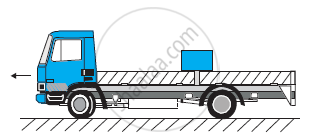
The rear side of a truck is open and a box of 40 kg mass is placed 5 m away from the open end as shown in Figure. The coefficient of friction between the box and the surface below it is 0.15. On a straight road, the truck starts from rest and accelerates with 2 m s–2. At what distance from the starting point does the box fall off the truck? (Ignore the size of the box).
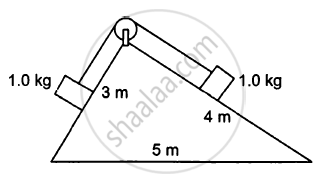
Consider the situation shown in the following figure All the surfaces are frictionless and the string and the pulley are light. Find the magnitude of acceleration of the two blocks.
Write the mathematical form of Newton's second law of motion. State the conditions if any.
How can Newton's first law of motion be obtained from the second law of motion?
Calculate the magnitude of force which when applied on a body of mass 0.5 kg produces an acceleration of 5 m s-2.
A car is moving with a uniform velocity 30 ms-1. It is stopped in 2 s by applying a force of 1500 N through its brakes. Calculate the following values : The change in momentum of car.
Multiple Choice Question. Select the correct option.
Which of the following are vector quantities?
Name the physical entity used for quantifying the motion of a body.
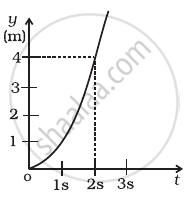
Figure shows (x, t), (y, t ) diagram of a particle moving in 2-dimensions.
|
|
 (b) |
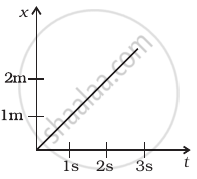
If the particle has a mass of 500 g, find the force (direction and magnitude) acting on the particle.
