Advertisements
Advertisements
प्रश्न
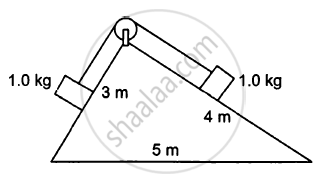
Consider the situation shown in the following figure All the surfaces are frictionless and the string and the pulley are light. Find the magnitude of acceleration of the two blocks.
Advertisements
उत्तर
Mass of each block is 1 kg, \[\sin \theta_1 = \frac{4}{5}\]
\[\sin \theta_2 = \frac{3}{5}\]
The free-body diagrams for both the boxes are shown below: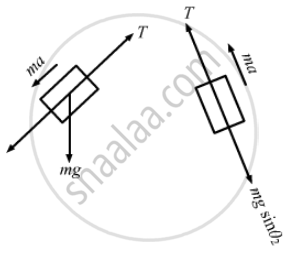
mgsinθ1 − T = ma ...(i)
T − mgsinθ2 = ma ...(ii)
Adding equations (i) and (ii),we get:
mg(sinθ1 − sinθ2) = 2ma
⇒ 2a = g (sinθ1 − sinθ2)
\[\Rightarrow a = \frac{g}{5} \times \frac{1}{2}\]
\[ = \frac{g}{10}\]
APPEARS IN
संबंधित प्रश्न
You are travelling in a car. The driver suddenly applies the brakes and you are pushed forward. Why does this happen?
An object is placed far away from all the objects that can exert force on it. A frame of reference is constructed by taking the origin and axes fixed in this object. Will the frame be necessarily inertial?
A smooth wedge A is fitted in a chamber hanging from a fixed ceiling near the earth's surface. A block B placed at the top of the wedge takes time T to slide down the length of the wedge. If the block is placed at the top of the wedge and the cable supporting the chamber is broken at the same instant, the block will.
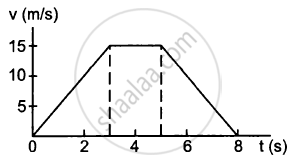
A particle of mass 50 g moves in a straight line. The variation of speed with time is shown in the following figure. Find the force acting on the particle at t = 2, 4 and 6 seconds.
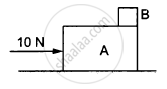
A small block B is placed on another block A of mass 5 kg and length 20 cm. Initially, the block B is near the right end of block A (In the following Figure). A constant horizontal force of 10 N is applied to the block A. All the surfaces are assumed frictionless. Find the time that elapses before block B separates from A.
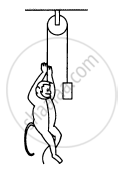
A monkey is climbing on a rope that goes over a smooth light pulley and supports a block of equal mass at the other end in the following figure. Show that whatever force the monkey exerts on the rope, the monkey and the block move in the same direction with equal acceleration. If initially both were at rest, their separation will not change as time passes.
Define linear momentum and state its S.I. unit.
State the Newton's second law of motion. What information do you get from it?
The linear momentum of a body of mass m moving with velocity v is :
A pebble is thrown vertically upwards with a speed of 20 m s-1. How high will it be after 2 s? (Take g = 10 m s-2)
A pebble is dropped freely in a well from its top. It takes 20 s for the pebble to reach the water surface in the well. Taking g = 10 m s-2 and speed of sound = 330 m s-1. Find : The depth of water surface
Define Newton’s second law of motion.
Multiple Choice Question. Select the correct option.
A force acts on a body of mass 3 kg such that its velocity changes from 4 ms−1 to 10 ms−1. The change in momentum of the body is
Which of the following has the largest inertia?
Use Newton's second law to explain the following:
We always prefer to land on sand instead of hard floor while taking a high jump.
A stone is thrown vertically upward with a velocity of 9.8 m/s. When will it reach the ground?
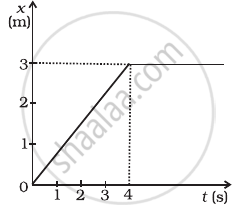
The position time graph of a body of mass 2 kg is as given in figure. What is the impulse on the body at t = 0 s and t = 4 s.
According to Newton's Second Law of Motion, what quantity is directly proportional to the applied force?
