Advertisements
Advertisements
प्रश्न
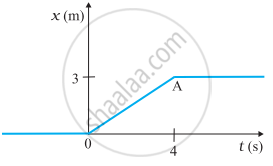
The below figure shows the position-time graph of a particle of mass 4 kg.
- What is the force on the particle for t < 0, t > 4 s, 0 < t < 4 s?
- What is the impulse at t = 0 and t = 4 s? (Consider one-dimensional motion only.)
Advertisements
उत्तर
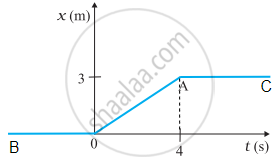
- For t < 0
For t<0, the graph of position versus time is denoted as BO, which indicates that the displacement of the particle is zero, i.e., the particle is stationary at the origin. Consequently, the force exerted on the particle must be zero. - For t > 4 s
For t>4 s, the position-time graph segment AC runs parallel to the time axis, indicating that the particle maintains a position 3 metres from the origin, implying it is stationary. Therefore, the force acting on the particle is zero. - For 0 < t < 4
Between 0 < t < 4 s, the position-time graph labelled OA displays a constant slope, which indicates that the velocity of the particle remains constant during this interval, meaning the particle has zero acceleration. Consequently, the force on the particle must be zero.
- For t < 0
- At t = 0
Impulse = Change in momentum
= mv – mu
Mass of the particle, m = 4 kg
Initial velocity of the particle, u = 0
Final velocity of the particle, `v = 3/4 "m/s"`
∴Impulse = `4(3/4 - 0) = 3 kg "m/s"`
At t = 4 s
Initial velocity of the particle, `u = 3/4 "m/s"`
Final velocity of the particle, v = 0
∴ Impulse = `4(0-3/4)` = -3 kg m/s
APPEARS IN
संबंधित प्रश्न
A constant retarding force of 50 N is applied to a body of mass 20 kg moving initially with a speed of 15 ms–1. How long does the body take to stop?
Explain why a cricketer moves his hands backwards while holding a catch.
A helicopter of mass 1000 kg rises with a vertical acceleration of 15 m s–2. The crew and the passengers weigh 300 kg. Give the magnitude and direction of the
(a) force on the floor by the crew and passengers,
(b) action of the rotor of the helicopter on the surrounding air,
(c) force on the helicopter due to the surrounding air.
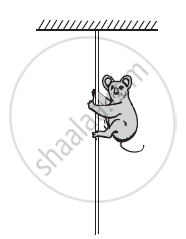
A monkey of mass 40 kg climbs on a rope in given Figure which can stand a maximum tension of 600 N. In which of the following cases will the rope break: the monkey
(a) climbs up with an acceleration of 6 m s–2
(b) climbs down with an acceleration of 4 m s–2
(c) climbs up with a uniform speed of 5 m s–1
(d) falls down the rope nearly freely under gravity?
(Ignore the mass of the rope).
A block of mass 15 kg is placed on a long trolley. The coefficient of static friction between the block and the trolley is 0.18. The trolley accelerates from rest with 0.5 ms–2 for 20 s and then moves with uniform velocity. Discuss the motion of the block as viewed by (a) a stationary observer on the ground, (b) an observer moving with the trolley.
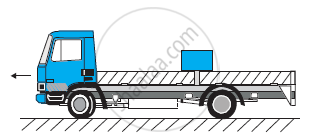
The rear side of a truck is open and a box of 40 kg mass is placed 5 m away from the open end as shown in Figure. The coefficient of friction between the box and the surface below it is 0.15. On a straight road, the truck starts from rest and accelerates with 2 m s–2. At what distance from the starting point does the box fall off the truck? (Ignore the size of the box).
A block of mass m is placed on a smooth wedge of inclination θ. The whole system is accelerated horizontally so that the block does not slip on the wedge. The force exerted by the wedge on the block has a magnitude.
A person says that he measured the acceleration of a particle to be non-zero even though no force was acting on the particle.
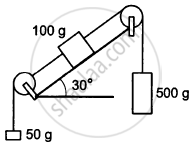
Find the acceleration of the 500 g block in the following figure.
A block is kept on the floor of an elevator at rest. The elevator starts descending with an acceleration of 12 m/s2. Find the displacement of the block during the first 0.2 s after the start. Take g = 10 m/s2.
An aeroplane is moving uniformly at a constant height under the action of two forces (i) Upward force (lift) and (ii) Downward force (weight). What is the net force on the aeroplane?
Define linear momentum and state its S.I. unit.
How can Newton's first law of motion be obtained from the second law of motion?
The correct form of Newton's second law is :
State the magnitude and direction of the force of gravity acting on the body of mass 5 kg. Take g = 9.8 m s-2.
A ball is thrown vertically upwards. It returns 6 s later. Calculate the greatest height reached by the ball. (Take g = 10 m s−2)
A pebble is dropped freely in a well from its top. It takes 20 s for the pebble to reach the water surface in the well. Taking g = 10 m s-2 and speed of sound = 330 m s-1. Find : The depth of water surface
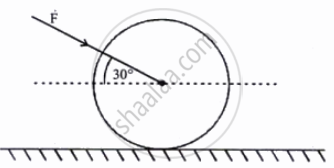
As shown in figure, a 70 kg garden roller is pushed with a force of F = 200 N at an angle of 30° with horizontal. The normal reaction on the roller is: (Given: g = 10 ms−2)