Advertisements
Advertisements
प्रश्न
Two bodies A and B of same mass are moving with velocities v and 2v, respectively. Compare their (i) inertia and (ii) momentum.
Advertisements
उत्तर
(i) Mass is the measure of inertia.
Let 'm' be the mass of the two bodies.
Inertia of body A:Inertia of body B :: m:m
Or, Inertia of body A:Inertia of body B :: 1:1
(ii) Momentum of body A = m (v)
Momentum of body B = m (2v) = 2mv
Momentum of body A:Momentum of body B :: mv:2mv
Or, Momentum of body A:Momentum of body B :: 1:2.
APPEARS IN
संबंधित प्रश्न
A block of mass 15 kg is placed on a long trolley. The coefficient of static friction between the block and the trolley is 0.18. The trolley accelerates from rest with 0.5 ms–2 for 20 s and then moves with uniform velocity. Discuss the motion of the block as viewed by (a) a stationary observer on the ground, (b) an observer moving with the trolley.
If the tension in the cable supporting an elevator is equal to the weight of the elevator, the elevator may be
(a) going up with increasing speed
(b) going down with increasing speed
(c) going up with uniform speed
(d) going down with uniform speed
A person says that he measured the acceleration of a particle to be non-zero even though no force was acting on the particle.
Define linear momentum and state its S.I. unit.
State the Newton's second law of motion. What information do you get from it?
Prove mathematically F = ma
ame the law of motion which gives the definition of force.
Use Newton's second law to explain the following:
While catching a fast moving ball, we always pull our hands backwards.
A cricket ball of mass 150 g has an initial velocity `u = (3hati + 4hatj)` m s−1 and a final velocity `v = - (3hati + 4hatj)` m s−1 after being hit. The change in momentum (final momentum-initial momentum) is (in kg m s1)
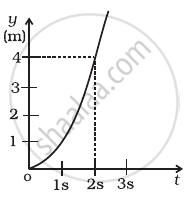
Figure shows (x, t), (y, t ) diagram of a particle moving in 2-dimensions.
|
|
 (b) |
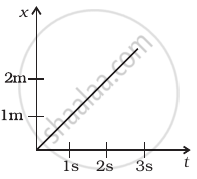
If the particle has a mass of 500 g, find the force (direction and magnitude) acting on the particle.
