Advertisements
Advertisements
प्रश्न
A force acts for 10 s on a stationary body of mass 100 kg, after which the force ceases to act. The body moves through a distance of 100 m in the next 5 s. Calculate: The velocity acquired by the body.
Advertisements
उत्तर
Mass, m = 100 kg
Distance moved, s = 100 m
Initial velocity, u = 0
Because the body moves through a distance of 100 m in 5 s,
Velocity of the body = `"Distance moved"/"time taken"`
Velocity = `100/5`
= 20 m/s
APPEARS IN
संबंधित प्रश्न
Two bodies of masses 10 kg and 20 kg respectively kept on a smooth, horizontal surface are tied to the ends of a light string. A horizontal force F = 600 N is applied to
- A,
- B along the direction of string. What is the tension in the string in each case?
A stone of mass m tied to the end of a string revolves in a vertical circle of radius R. The net forces at the lowest and highest points of the circle directed vertically downwards are: [Choose the correct alternative]
| Lowest Point | Highest Point | |
| a) | mg – T1 | mg + T2 |
| b) | mg + T1 | mg – T2 |
| c) | `mg + T1 –(m_v_1^2)/R` | mg – T2 + (`mv_1^2`)/R |
| d) | `mg – T1 – (mv)/R` | mg + T2 + (mv_1^2)/R |
T1 and v1 denote the tension and speed at the lowest point. T2 and v2 denote corresponding values at the highest point.
Suppose you are running fast in a field and suddenly find a snake in front of you. You stop quickly. Which force is responsible for your deceleration?
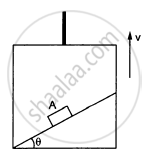
A block A can slide on a frictionless incline of angle θ and length l, kept inside an elevator going up with uniform velocity v in the following figure. Find the time taken by the block to slide down the length of the incline if it is released from the top of the incline.
A ball is thrown vertically upwards. It returns 6 s later. Calculate the greatest height reached by the ball. (Take g = 10 m s−2)
ame the law of motion which gives the definition of force.
Use Newton's second law to explain the following:
We always prefer to land on sand instead of hard floor while taking a high jump.
The INCORRECT statement about Newton's second law of motion is
According to Newton's Second Law of Motion, what quantity is directly proportional to the applied force?
How does moving your hand backward while catching a cricket ball reduce pain?
