Advertisements
Advertisements
प्रश्न
Explain why a cricketer moves his hands backwards while holding a catch.
Advertisements
उत्तर
According to Newton’s second law of motion, we have the equation of motion:
F = ma = `m (trianglev)/(trianglet)` ....(i)
Where
F = Stopping force experienced by the cricketer as he catches the ball
m = Mass of the ball
Δt = Time of impact of the ball with the hand
From equation (i), it is deducible that there is an inverse proportionality between the impact force and the impact time, i.e.
`F prop 1/(trianglet)` ......(ii)
Equation (ii) demonstrates that as the time of impact increases, the force experienced by the cricketer decreases and vice versa.
During a catch, a cricketer pulls his hands backward to lengthen the time of impact (Δt). This leads to a reduction in the stopping force, which helps protect the cricketer's hands from harm.
APPEARS IN
संबंधित प्रश्न
A person drops a coin. Describe the path of the coin as seen by the person if he is in
- a car moving at constant velocity and
- in a free falling elevator.
A person says that he measured the acceleration of a particle to be non-zero even though no force was acting on the particle.
Two blocks of equal mass m are tied to each other through a light string. One of the blocks is pulled along the line joining them with a constant force F. Find the tension in the string joining the blocks.
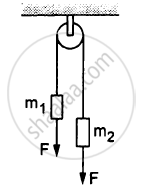
In the following figure, m1 = 5 kg, m2 = 2 kg and F = 1 N. Find the acceleration of either block. Describe the motion of m1 if the string breaks but F continues to act.
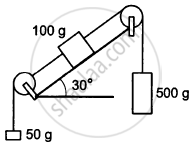
Find the acceleration of the 500 g block in the following figure.
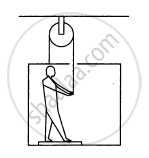
In the following figure shows a man of mass 60 kg standing on a light weighing machine kept in a box of mass 30 kg. The box is hanging from a pulley fixed to the ceiling by a light rope, the other end of which is held by the man himself. If the man manages to keep the box at rest, what is the weight recorded on the machine? What force should he exert on the rope to record his correct weight on the machine?
How can Newton's first law of motion be obtained from the second law of motion?
A body of mass 5 kg is moving with velocity 2 m s-1. Calculate its linear momentum.
A ball is thrown vertically upwards. It returns 6 s later. Calculate the greatest height reached by the ball. (Take g = 10 m s−2)
What do you understand by the term momentum?
State two factors which determine the momentum of a body.
Prove mathematically F = ma
What causes motion in a body?
Use Newton's second law to explain the following:
We always prefer to land on sand instead of hard floor while taking a high jump.
A stone is dropped from a cliff 98 m high.
How long will it take to fall to the foot of the cliff?
What do you mean by the conservation of momentum? Briefly, explain the collision between two bodies and the conservation of momentum.
A cricket ball of mass 150 g has an initial velocity `u = (3hati + 4hatj)` m s−1 and a final velocity `v = - (3hati + 4hatj)` m s−1 after being hit. The change in momentum (final momentum-initial momentum) is (in kg m s1)
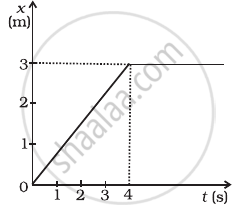
The position time graph of a body of mass 2 kg is as given in figure. What is the impulse on the body at t = 0 s and t = 4 s.
A woman throws an object of mass 500 g with a speed of 25 ms1.
- What is the impulse imparted to the object?
- If the object hits a wall and rebounds with half the original speed, what is the change in momentum of the object?
