Advertisements
Advertisements
प्रश्न
A ball is thrown vertically upwards. It returns 6 s later. Calculate the greatest height reached by the ball. (Take g = 10 m s−2)
Advertisements
उत्तर
Given:
Total time of journey = 6 s
g = 10 m/s2
Let h be the greatest height.
From the equation of motion,
`h = ut + 1/2 g t^2`
(we consider motion of ball from highest point to the ground.)
Since the total time for journey of the ball in air = 6 s.
Therefore, time for reaching maximum height = `6/2` = 3 s
For ascent, initial velocity, u = 0
Substituting the values in the formula, we get,
`h = (0 xx 3) + (1/2 xx 10 xx 3^2)`
h = 0 + (5 × 9)
h = 45 m
Hence, greatest height reached by the ball = 45 m
APPEARS IN
संबंधित प्रश्न
A stone of mass m tied to the end of a string revolves in a vertical circle of radius R. The net forces at the lowest and highest points of the circle directed vertically downwards are: [Choose the correct alternative]
| Lowest Point | Highest Point | |
| a) | mg – T1 | mg + T2 |
| b) | mg + T1 | mg – T2 |
| c) | `mg + T1 –(m_v_1^2)/R` | mg – T2 + (`mv_1^2`)/R |
| d) | `mg – T1 – (mv)/R` | mg + T2 + (mv_1^2)/R |
T1 and v1 denote the tension and speed at the lowest point. T2 and v2 denote corresponding values at the highest point.
A block of mass 15 kg is placed on a long trolley. The coefficient of static friction between the block and the trolley is 0.18. The trolley accelerates from rest with 0.5 ms–2 for 20 s and then moves with uniform velocity. Discuss the motion of the block as viewed by (a) a stationary observer on the ground, (b) an observer moving with the trolley.
Two blocks A and B of mass mA and mB , respectively, are kept in contact on a frictionless table. The experimenter pushes block A from behind, so that the blocks accelerate. If block A exerts force F on block B, what is the force exerted by the experimenter on block A?
The force of buoyancy exerted by the atmosphere on a balloon is B in the upward direction and remains constant. The force of air resistance on the balloon acts opposite the direction of velocity and is proportional to it. The balloon carries a mass M and is found to fall to the earth's surface with a constant velocity v. How much mass should be removed from the balloon so that it may rise with a constant velocity v?
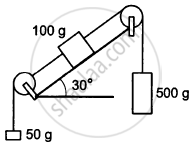
Find the acceleration of the 500 g block in the following figure.
A force acts for 10 s on a stationary body of mass 100 kg, after which the force ceases to act. The body moves through a distance of 100 m in the next 5 s. Calculate : The magnitude of the force
A pebble is thrown vertically upwards with a speed of 20 m s-1. How high will it be after 2 s? (Take g = 10 m s-2)
Define Newton’s second law of motion.
What do you mean by an impulsive force?
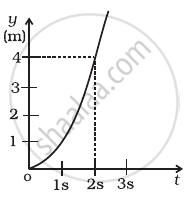
Figure shows (x, t), (y, t ) diagram of a particle moving in 2-dimensions.
|
|
 (b) |
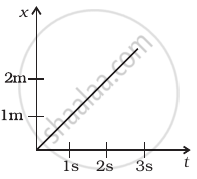
If the particle has a mass of 500 g, find the force (direction and magnitude) acting on the particle.
