Advertisements
Advertisements
प्रश्न
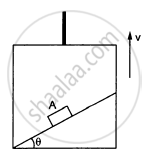
A block A can slide on a frictionless incline of angle θ and length l, kept inside an elevator going up with uniform velocity v in the following figure. Find the time taken by the block to slide down the length of the incline if it is released from the top of the incline.
Advertisements
उत्तर
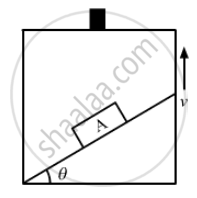
The force on the block which makes the body move down the plane is the component of its weight parallel to the inclined surface.
F = mg sinθ
Acceleration, g = sin θ
Initial velocity of block, u = 0
Distance to be covered
s = l
a = g sin θ
Using, \[s = ut + \frac{1}{2}a t^2\]
\[l = 0 + \frac{1}{2}\left( g\sin\theta \right) t^2 \]
\[ \Rightarrow t^2 = \frac{2l}{g\sin\theta}\]
\[ \Rightarrow \text{ Time taken }, t ={\sqrt{\frac{2l}{gsin\theta}}}\]
APPEARS IN
संबंधित प्रश्न
Two masses 8 kg and 12 kg are connected at the two ends of a light, inextensible string that goes over a frictionless pulley. Find the acceleration of the masses, and the tension in the string when the masses are released.
A person drops a coin. Describe the path of the coin as seen by the person if he is in
- a car moving at constant velocity and
- in a free falling elevator.
A free 238U nucleus kept in a train emits an alpha particle. When the train is stationary, a nucleus decays and a passenger measures that the separation between the alpha particle and the recoiling nucleus becomes x at time t after the decay. If the decay takes place while the train is moving at a uniform velocity v, the distance between the alpha particle and the recoiling nucleus at a time t after the decay, as measured by the passenger, is
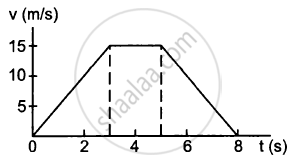
A particle of mass 50 g moves in a straight line. The variation of speed with time is shown in the following figure. Find the force acting on the particle at t = 2, 4 and 6 seconds.
Consider the Atwood machine of the previous problem. The larger mass is stopped for a moment, 2.0 s after the system is set into motion. Find the time that elapses before the string is tight again.
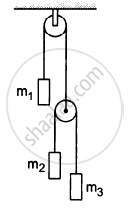
Let m1 = 1 kg, m2 = 2 kg and m3 = 3 kg in the following figure. Find the accelerations of m1, m2 and m3. The string from the upper pulley to m1 is 20 cm when the system is released from rest. How long will it take before m1 strikes the pulley?
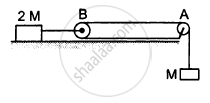
Consider the situation shown in the following figure. Both the pulleys and the string are light and all the surfaces are frictionless.
- Find the acceleration of the mass M.
- Find the tension in the string.
- Calculate the force exerted by the clamp on the pulley A in the figure.
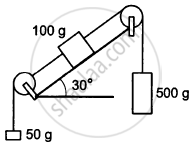
Find the acceleration of the 500 g block in the following figure.
A monkey of mass 15 kg is climbing a rope fixed to a ceiling. If it wishes to go up with an acceleration of 1 m/s2, how much force should it apply on the rope? If the rope is 5 m long and the monkey starts from rest, how much time will it take to reach the ceiling?
State the Newton's second law of motion. What information do you get from it?
A body of mass 5 kg is moving with velocity 2 m s-1. Calculate its linear momentum.
A pebble is dropped freely in a well from its top. It takes 20 s for the pebble to reach the water surface in the well. Taking g = 10 m s-2 and speed of sound = 330 m s-1. Find : The depth of water surface
ame the law of motion which gives the definition of force.
A stone is dropped from a cliff 98 m high.
What will be its speed when it strikes the ground?
In the previous problem (5.3), the magnitude of the momentum transferred during the hit is ______.
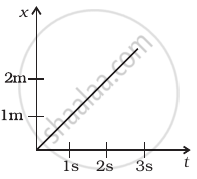
The position time graph of a body of mass 2 kg is as given in figure. What is the impulse on the body at t = 0 s and t = 4 s.
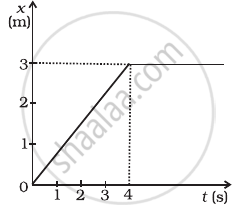
A woman throws an object of mass 500 g with a speed of 25 ms1.
- What is the impulse imparted to the object?
- If the object hits a wall and rebounds with half the original speed, what is the change in momentum of the object?
Figure shows (x, t), (y, t ) diagram of a particle moving in 2-dimensions.
|
|
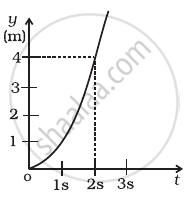 (b) |
If the particle has a mass of 500 g, find the force (direction and magnitude) acting on the particle.
