Advertisements
Advertisements
प्रश्न
A body of mass 200 g is moving with a velocity of 5 ms−1. If the velocity of the body changes to 17 ms−1, calculate the change in linear momentum of the body.
Advertisements
उत्तर
Mass of body = m = 200 g = 0.2 kg
Velocity = v1 = 5 ms−1; Velocity = v2 = 17 ms−1
Change in linear momentum of body
= mv2 – mv1= m (v2 – v1)
= 0.2(17-5)
= 2.4 Ns or kg ms−1
APPEARS IN
संबंधित प्रश्न
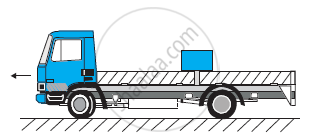
The rear side of a truck is open and a box of 40 kg mass is placed 5 m away from the open end as shown in Figure. The coefficient of friction between the box and the surface below it is 0.15. On a straight road, the truck starts from rest and accelerates with 2 m s–2. At what distance from the starting point does the box fall off the truck? (Ignore the size of the box).
car moving at 40 km/hr is to be stopped by applying brakes in the next 4 m. If the car weighs 2000 kg, what average force must be applied to stop it?
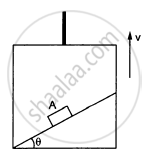
A block A can slide on a frictionless incline of angle θ and length l, kept inside an elevator going up with uniform velocity v in the following figure. Find the time taken by the block to slide down the length of the incline if it is released from the top of the incline.
The correct form of Newton's second law is :
How long will a stone take to fall to the ground from the top of a building 80 m high
What causes motion in a body?
A stone is dropped from a tower 98 m high. With what speed should a second stone be thrown 1 s later so that both hit the ground at the same time?
In the previous problem (5.3), the magnitude of the momentum transferred during the hit is ______.
A body of mass 2 kg travels according to the law x(t) = pt + qt2 + rt3 where p = 3 ms−1, q = 4 ms−2 and r = 5 ms−3. The force acting on the body at t = 2 seconds is ______.
Why does a child feel more pain when she falls down on a hard cement floor, than when she falls on the soft muddy ground in the garden?
