Advertisements
Advertisements
प्रश्न
How long will a stone take to fall to the ground from the top of a building 80 m high
Advertisements
उत्तर
Height, s = 80m
g = 10 m/s2
Using the second equation of motion,
S = ut + (1/2) gt2
Or, 80 = 0+ (1/2) (10) (t) 2
Or, (t) 2 = 16
Or, t = 4s
APPEARS IN
संबंधित प्रश्न
A man of mass 70 kg stands on a weighing scale in a lift which is moving
- upwards with a uniform speed of 10 m s-1
- downwards with a uniform acceleration of 5 m s–2
- upwards with a uniform acceleration of 5 m s–2. What would be the readings on the scale in each case?
- What would be the reading if the lift mechanism failed and it hurtled down freely under gravity?
Explain why a cricketer moves his hands backwards while holding a catch.
In a simple Atwood machine, two unequal masses m1 and m2 are connected by a string going over a clamped light smooth pulley. In a typical arrangement (In the following figure), m1 = 300 g and m2 = 600 g. The system is released from rest. (a) Find the distance travelled by the first block in the first two seconds; (b) find the tension in the string; (c) find the force exerted by the clamp on the pulley.
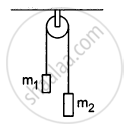
Consider the Atwood machine of the previous problem. The larger mass is stopped for a moment, 2.0 s after the system is set into motion. Find the time that elapses before the string is tight again.
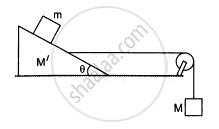
Find the mass M of the hanging block in the following figure that will prevent the smaller block from slipping over the triangular block. All the surfaces are frictionless and the strings and the pulleys are light.
The correct form of Newton's second law is :
State two factors which determine the momentum of a body.
Use Newton's second law to explain the following:
While catching a fast moving ball, we always pull our hands backwards.
The INCORRECT statement about Newton's second law of motion is
A cricket ball of mass 150 g has an initial velocity `u = (3hati + 4hatj)` m s−1 and a final velocity `v = - (3hati + 4hatj)` m s−1 after being hit. The change in momentum (final momentum-initial momentum) is (in kg m s1)
