Advertisements
Advertisements
प्रश्न
A pebble is thrown vertically upwards with a speed of 20 m s-1. How high will it be after 2 s? (Take g = 10 m s-2)
Advertisements
उत्तर
Initial velocity, u = 20 m/s
Time, t = 2s
g = 10 m/s2
Maximum height reached in 2s, H = (1/2) gt2
Or, H = (1/2) (10) (2) 2
Or, H = 20 m
APPEARS IN
संबंधित प्रश्न
A block of mass 15 kg is placed on a long trolley. The coefficient of static friction between the block and the trolley is 0.18. The trolley accelerates from rest with 0.5 ms–2 for 20 s and then moves with uniform velocity. Discuss the motion of the block as viewed by (a) a stationary observer on the ground, (b) an observer moving with the trolley.
You are travelling in a car. The driver suddenly applies the brakes and you are pushed forward. Why does this happen?
A smooth wedge A is fitted in a chamber hanging from a fixed ceiling near the earth's surface. A block B placed at the top of the wedge takes time T to slide down the length of the wedge. If the block is placed at the top of the wedge and the cable supporting the chamber is broken at the same instant, the block will.
A person says that he measured the acceleration of a particle to be non-zero even though no force was acting on the particle.
Two blocks of equal mass m are tied to each other through a light string. One of the blocks is pulled along the line joining them with a constant force F. Find the tension in the string joining the blocks.
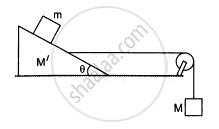
Find the mass M of the hanging block in the following figure that will prevent the smaller block from slipping over the triangular block. All the surfaces are frictionless and the strings and the pulleys are light.
Multiple Choice Question. Select the correct option.
The impulse of a body is equal to:
Which of the following has the largest inertia?
What do you mean by linear momentum of a body? A force causes an acceleration of 10 ms-2 in a body of mass 1 kg. What acceleration will be caused by the same force in a body of mass 4 kg?
A metre scale is moving with uniform velocity. This implies ______.
